Audio Overview
Listen to an AI-generated discussion of this article
Starting a cottage food business is exciting — but once you've perfected your recipe and set up your kitchen, you hit the hardest part: getting your first customers.
This is the cold start problem. No reviews, no followers, no word of mouth. Just you and your product.
We studied a real cottage food baker — a Greek baklava business in Ohio — who went from zero to 30 paying customers and over $1,200 in revenue in five months using nothing but a Facebook page and a simple website. We analyzed every single post she made, every order she received, and every visitor to her site.
Here's what we learned.
The Baker: My Granny's Baklava
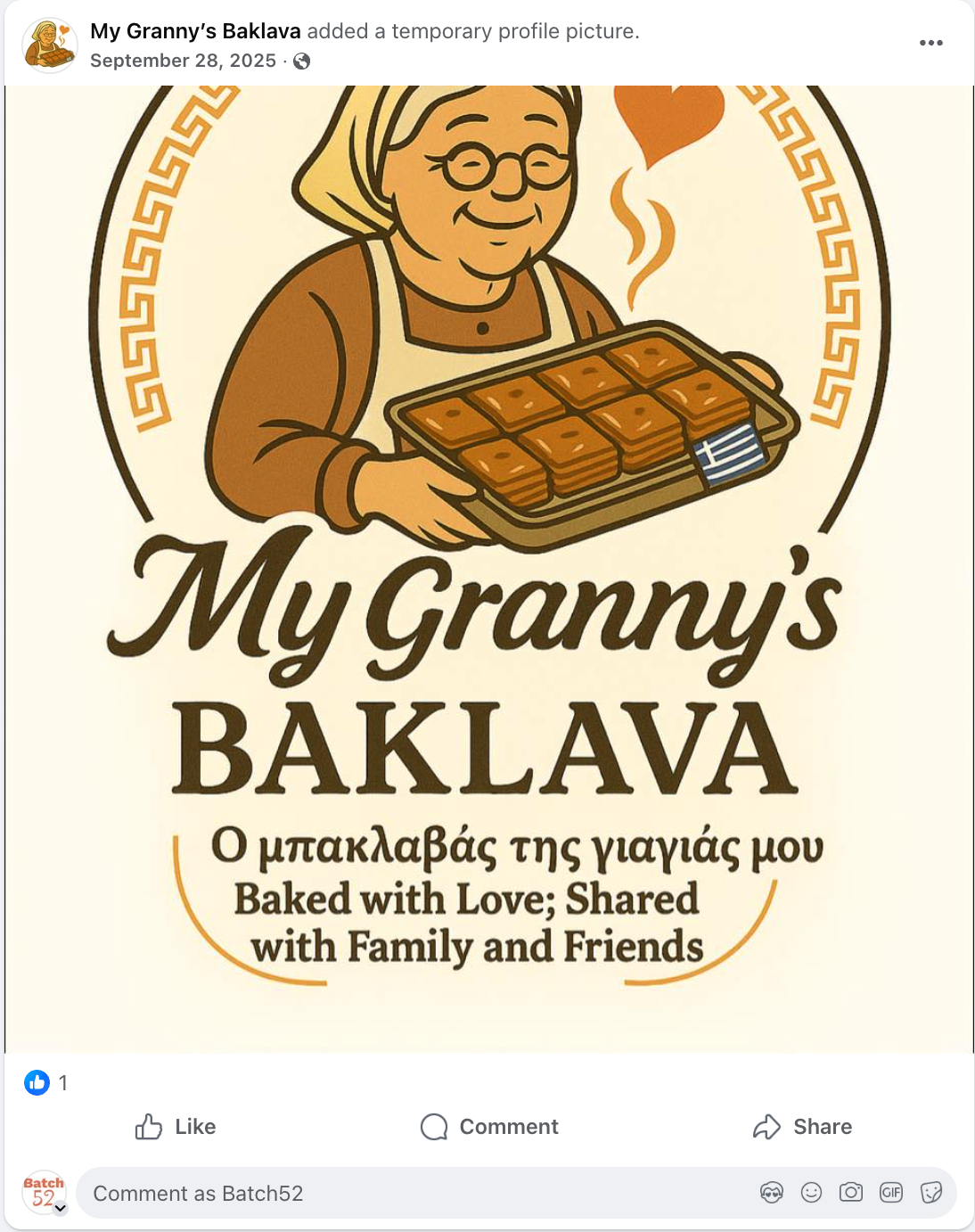
Teresa started her Facebook business page on September 28, 2025, with nothing but a logo as her profile picture. She had no followers, no email list, and no existing customer base.
Her product: authentic Greek honey walnut baklava, baked fresh from a family recipe. Porch pickup only in the Toledo, Ohio area. You can see her shop at MyGrannysBaklava.com.
Within five months, she had:
- 134 Facebook followers
- 30 unique paying customers
- $1,285 in total revenue
- 7 five-star reviews (100% recommendation rate)
- 8 repeat buyers who came back again and again
These numbers might seem modest, but for a one-person cottage food operation with no advertising budget, they represent real, sustainable growth. And the patterns behind them apply to any home baker starting from scratch.
What She Tried: 61 Posts in 5 Months
Teresa posted consistently — about 3 times per week — and she tried everything. That's the first lesson: you have to experiment.
Here's a breakdown of the types of content she posted:
| Content Type | Posts | Examples |
|---|---|---|
| Product availability / "Now taking orders" | ~15 | "Fresh baked today!" flyers, "15 Large Boxes ready for order" |
| Seasonal / holiday promotions | ~12 | Valentine's gift baskets, Christmas stocking stuffers, holiday order deadlines |
| Heritage & personal storytelling | ~8 | Family photos, grandmother's story, Greek traditions |
| Cultural & religious | ~5 | Greek Christmas greeting, Clean Monday / Lent traditions |
| Educational / comparison | ~4 | "What's in your morning Danish?" commercial vs. homemade comparison |
| Event promotions | ~4 | Craft show flyers, Marketplace Mania |
| Reels & video | ~5 | Product showcase videos, Valentine's reels |
| Social proof & reviews | ~4 | Google review screenshots, customer testimonials |
| "Sold Out" announcements | ~3 | "SOLD OUT! THANK YOU!" |
| Cross-promotions | ~2 | Sharing a friend's crochet business |
She didn't stick to one formula. She tried flyers, reels, personal shares, educational infographics, cultural posts, and more. Most of it didn't work. But finding the things that did work was worth every experiment.
The Posts That Actually Drove Sales
Out of 61 posts, a handful drove the vast majority of orders. Here are the patterns that emerged.
Pattern 1: "Now Taking Orders" Posts Are the #1 Revenue Driver
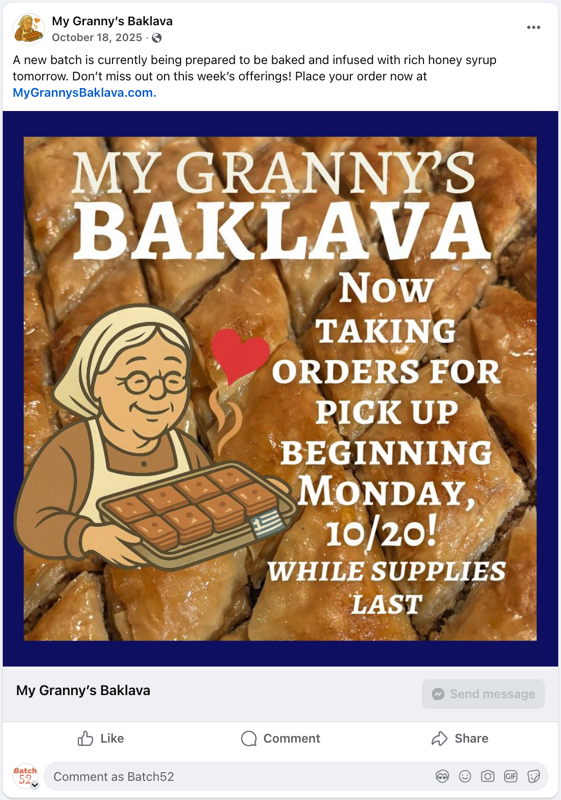
The single most effective thing Teresa did was post availability announcements every time a new batch was ready.
On October 18, she posted a simple flyer: "NOW TAKING ORDERS FOR PICK UP BEGINNING MONDAY, 10/20!"
Within 48 hours, she received 6 orders from 6 different customers — her biggest order cluster of the month. The post itself got modest engagement (about 2 reactions), but it didn't matter. The people who saw it were ready to buy.
This pattern repeated throughout the business:
- October 5: "Fresh baked today, Sunday 10/5!" → order same day
- October 7: "15 Large Boxes and 2 Small Boxes ready for order" → orders within 2 days
- November 15: "Hostess gifts and 4 piece boxes available for porch pickup!" → 4 orders that week
- December 15: "Six pieces of PECAN baklava are available!" → $116 order same day (her biggest single order ever)
The takeaway: Don't overthink it. When your product is ready, tell people. A simple "fresh batch available, order now" post with your website link will outperform fancy content every time.
Pattern 2: Heritage Storytelling Brings New Customers
On January 5, Teresa posted a photo of her actual grandmother alongside an illustration, with the caption "Baklava. Every Layer Tells a Story..."
It was her best organic post ever: 11 reactions, 2 comments, and 7 shares. More importantly, within 5 days, 3 people who had never ordered before placed their first orders. These were people who discovered the business through shares — friends of friends who were introduced to the brand through Teresa's personal story.
Compare that to her Valentine's Day content (more on that below), which generated more engagement but zero new customers.
Why heritage storytelling works:
When someone shares a post about your grandmother's recipe, they're not just sharing an ad — they're sharing a story. The people who see it arrive at your page already feeling a connection. They're primed to buy.
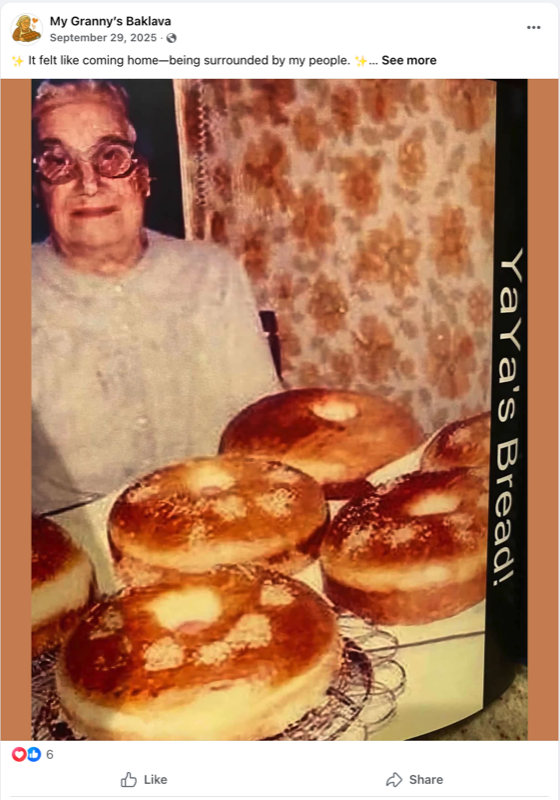
Teresa's very first heritage post — a photo of her YiaYia with the caption "It felt like coming home" — drew a comment from someone who said, "Please open your own business." She already had.
Pattern 3: "Sold Out" Creates Urgency for the Next Batch
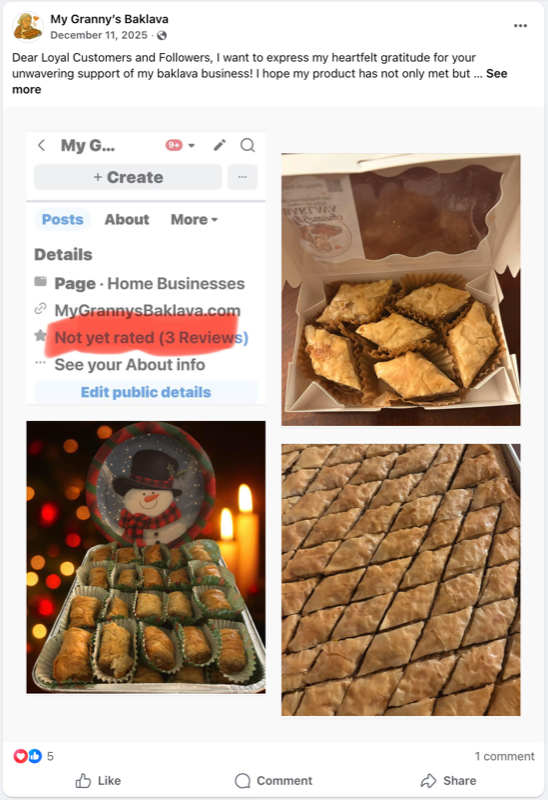
When Teresa posted that she was sold out, something interesting happened: people responded with purchase intent.
After her December 11 "SOLD OUT!" announcement, her most loyal customer commented, "I'll take one if still available" — and placed an order the next day. After the October 29 "CURRENTLY SOLD OUT" post, another customer reordered at 4x her original amount.
Scarcity is real. When people see that your product sells out, they don't want to miss the next batch. These posts cost nothing to make and create genuine urgency.
The Biggest Surprise: What Didn't Work
Not everything drove sales. Some content that looked successful by engagement metrics completely failed to generate orders.
The Valentine's Day Trap
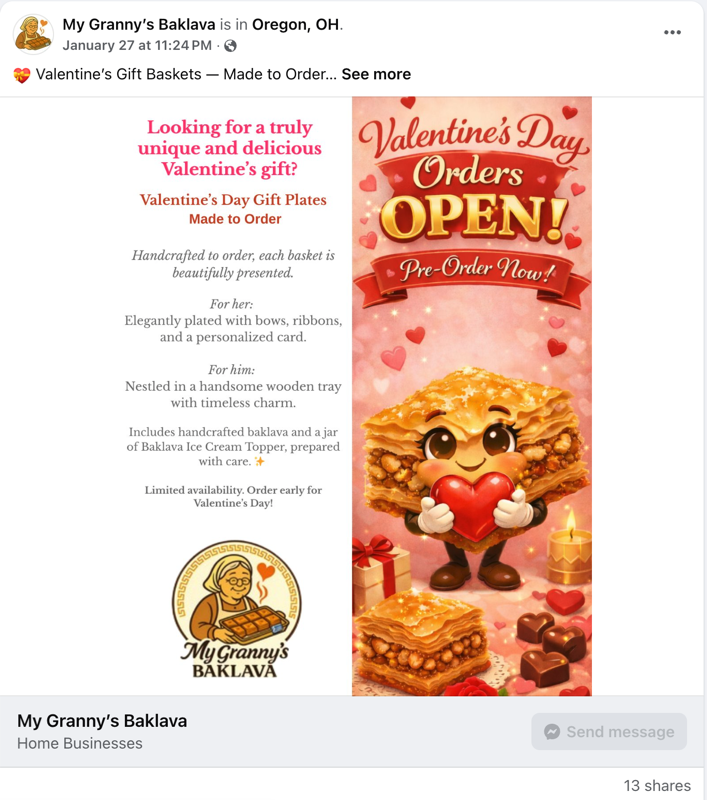
Between January 16 and 28, Teresa posted 7 Valentine's Day-themed posts — reels, gift basket flyers, "baklava is a gift of love" photo albums. Some of these got solid engagement. The January 20 post got 6 shares. A reel got 107 views.
The result? Zero orders. Not one.
Even more striking: her website traffic data showed that Valentine's content drove the highest visitor count of any week — 148 unique visitors in the week of January 12. But those visitors had a terrible conversion rate. They came to look, not to buy.
Meanwhile, the week of January 5 (driven by the heritage "Every Layer" post) had 40% fewer visitors but 4x the revenue.
The lesson: Engagement and traffic are not the same as sales. Aspirational content ("imagine giving this as a gift!") attracts window shoppers. Availability content ("order now, pickup Tuesday") attracts buyers.
Reels Get Views, Not Customers
Teresa's reels got the most views of any content type — 107 and 132 views respectively. But they generated almost no reactions, no comments, and no traceable orders.
Views are the most misleading metric on social media. A view means someone's thumb paused for a moment while scrolling. It doesn't mean they read your post, visited your page, or thought about ordering.
The 73-Reaction Post That Generated Zero Sales
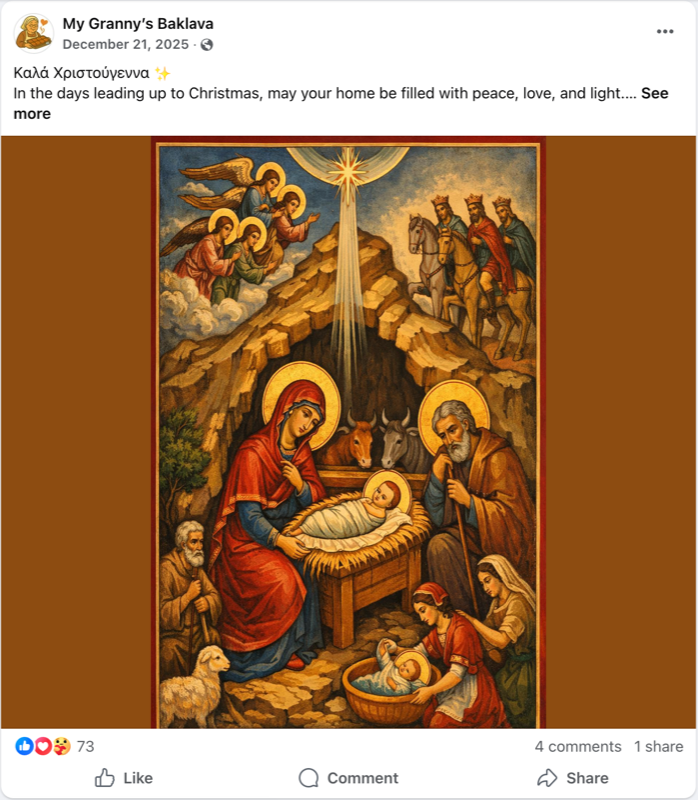
Teresa's most "viral" post by far was a Greek Christmas greeting on December 21 — a beautiful Nativity icon with "Kala Christougenna" (Merry Christmas). It received 73 reactions — more than 10x her average post.
But it generated zero orders. Cultural engagement and purchase intent are completely different things. People who react to a holiday greeting aren't thinking about buying baklava. They're feeling festive.
This doesn't mean cultural posts are useless. They build community, and community matters. But don't mistake a popular post for a profitable one.
The Secret Weapon: Repeat Customers
Here's the finding that surprised us most: 8 repeat buyers generated nearly half of all revenue.
| Customer | Orders | Total Spent | Pattern |
|---|---|---|---|
| A.C. | 2 | $144 | Large orders, quarterly |
| N.C. | 2 | $144 | Large holiday orders |
| P.K. | 2 | $80 | Escalated from $16 → $64 |
| G.H. | 4 | $72 | Monthly small orders, most loyal |
| A.H. | 2 | $72 | Mid-size, followed availability posts |
| L.W. | 2 | $64 | Both orders in October |
| J.K. | 2 | $31 | Small holiday gift orders |
| D.P./G.P. | 3 | $26 | Family, started small and kept coming back |
That's $633 from just 8 people — 48% of total revenue.
And here's the kicker: the highest-spending customers were NOT the most active on Facebook. The two highest spenders — $144 each — never commented on a single post. They were silent followers who saw a post, visited the site, and ordered.
The most vocal Facebook commenter was also a loyal buyer (4 orders) — but the customers who spent the most were invisible on social media.
What this means for you: Once someone buys from you, they are worth far more than a new follower. A simple text message to your past customers when a new batch is ready ("Hey, fresh baklava this Tuesday — want me to save you a box?") is more valuable than any Facebook post.
The Week With No Posts and 3 Orders
The most counterintuitive data point: during the week of February 9, Teresa posted nothing on Facebook. Zero posts.
She still got 3 orders from 3 different repeat customers, with a 75% cart-to-order rate on her website.
Repeat buyers don't need to be reminded through social media. They already know they love your product. They just need to know it's available — and by this point, they were checking the website directly.
This is what solving the cold start problem looks like. You start by posting to attract strangers. Over time, those strangers become customers. And eventually, your customers come to you.
The Holiday Blitz: When Consistent Posting Pays Off
Teresa's best revenue period was the holiday season: November 23 through December 18. During this stretch, she posted almost daily — availability updates, deadline reminders, gift ideas, "sold out" announcements.
The result: $555 in revenue in four weeks — 43% of her all-time total.
This wasn't one viral post. It was the accumulation of consistent posting over the holiday season, layering:
- Emotional hooks — "Let the holidays begin!" behind-the-scenes photos
- Availability — "Dear Loyal Customers" with product photos
- Urgency — "Order by Dec 10" deadline
- Scarcity — "SOLD OUT! THANK YOU!"
- A boosted reel — Her December 1 baklava video, which she paid to promote, correlated with her strongest week by number of unique customers
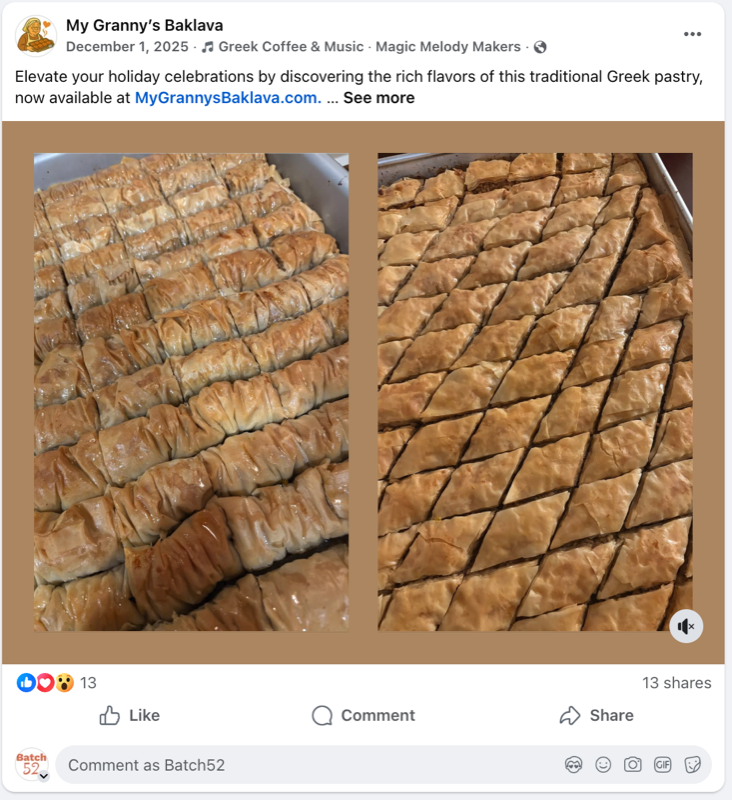
The boosted reel is worth noting: it was one of only two posts Teresa paid to promote, and it was the only one that clearly correlated with a sales spike. If you're going to spend money on a boost, do it during your peak season when people are already in a buying mindset.
Your Cold Start Playbook
Based on five months of real data, here's what actually works when you're starting from zero:
Week 1-2: Set Up and Launch
- Create your Facebook business page with a clear profile photo of your product
- Post your story — why you bake, who taught you, what makes your recipe special
- Tell your personal network (friends, family) to follow and share
Ongoing: The Three Posts That Matter
Post #1: "Now Available" (every time you bake) This is your most important post. When a batch is ready, post immediately with:
- What's available and how much
- How to order (link to your website or a phone number)
- Pickup details
This single post type drove more revenue than all other content combined.
Post #2: Your Story (monthly) One heritage/personal post per month. Your grandmother's recipe. Your first bake. Why this matters to you. These posts get shared and bring new customers who feel connected to your brand before they ever taste your product.
Post #3: Sold Out (when it happens) Don't be shy about selling out. Post it. It creates urgency for next time and makes people feel like they need to order faster.
What You Can Skip
- Reels and videos (views don't convert to sales)
- Educational infographics (interesting but don't sell)
- Aspirational seasonal content without a clear order link
- "Please review us" posts (ask in person instead)
The Real Growth Engine
Social media gets you started, but repeat customers are what sustain you. After your first 10 customers:
- Save their contact info
- Text or message them directly when a new batch is ready
- They don't need a Facebook post — they just need to know it's available
- 8 repeat buyers generated 48% of this baker's revenue
The Bottom Line
Solving the cold start problem doesn't require going viral or mastering social media algorithms. It requires:
- Consistency — 3 posts a week, every week
- Experimentation — Try different content types and pay attention to what actually drives orders (not likes)
- Availability announcements — The simplest, most effective post you can make
- Your personal story — The one thing no competitor can copy
- Nurturing repeat buyers — Your first 10 customers are worth more than your next 100 followers
Teresa went from zero followers to a sustainable cottage food business in five months. Not because she cracked the algorithm or went viral — but because she showed up, posted consistently, and paid attention to what worked.
You can do the same thing. Start posting today. Most of it won't work. But the things that do work will surprise you — and they'll be enough.