You bake in your own kitchen. Somebody told you to get on Google Maps, and the first form wants a category that describes you, then the address of the house where you sleep. The form was built for a business with a door and a sign.
On 4 September 2026 we walked Google's live signup flow and typed bakery words into the real category field. There is no category for a home bakery. And the advice everyone gives about hiding your address is right, but it will cost you.
Key takeaways
- Google's category list has no home bakery entry. Typing "custom cake" into the live field on 4 September 2026 returned nine categories and not one was food; "home bakery" returned exactly two. Pick Bakery or Cake shop.
- Primary category ranked 1st of 187 map-results ranking factors at 227 points in Whitespark's 2026 survey of 47 experts. Keywords in your profile description ranked 171st.
- Google's guidelines tell a business with no permanent signage to hide its address as a service-area business, but the same survey ranks "Address Is Showing on GBP" 7th of 187. Those experts say hiding it costs you ranking weight.
- The two statistics that open most guides on this are unsourced. "46% of Google searches have local intent" traces to a 2018 tweet about a remark at a Google event, and Google's "70% more likely to visit" sits on its own help page with no study and no date.
- Google's map results, the handful of businesses shown on a map above the blue links, appeared on roughly 36% of US search results pages across 60 million queries measured in 2021, so they sit on a third of result pages, not most.
How to set up a Google Business Profile for a home bakery
- Check that you qualify: you deliver to customers, or customers come to you in person at stated hours.
- Pick Bakery or Cake shop as your primary category before you open the form. Add Mobile caterer only if catering is a real part of what you sell.
- Enter your real business name with nothing appended.
- If you deliver, hide the address and set your own service areas so Google does not pick one for you.
- Publish your pickup hours if you keep regular ones. If you work by appointment only, leave hours off.
- Add a phone number you control and a link that takes orders.
- Finish whichever verification Google assigns. If it is a postcard, do not touch the name, address or category while you wait.
- Get to twenty reviews by asking every customer.
The recommendation up front: create the profile, and if you deliver, list it as a service-area business and hide the street address, knowing the experts surveyed below think that costs ranking weight. If customers only collect from your door and you have no sign, Google's rules are less clear, and the eligibility section says where. That holds at six orders a month and at sixty. With a commercial kitchen and a sign, none of it applies. I build Batch52, so I have a stake in you having somewhere to send orders.
Is a Google Business Profile worth it for a home baker?
Yes, and the map results are a third of searches, not most. Those results, the businesses Google shows on a map above the blue links, appeared on roughly 36% of US search results pages in the last public measurement we could trace, across 60 million queries, March 2021.
The better argument is who a profile reaches. In BrightLocal's study of 45,000 listings, published in 2019 from data collected in 2017 and 2018, the average profile turned up in 1,009 searches a month, 84% of them discovery searches rather than someone typing the name. People who know you already find you in your DMs. The profile is for the ones who do not. The scale, in that same 2019 study: an average 1,260 views and 59 actions a month.
Two statistics open almost every other article on this subject. Neither appears here as a fact. "46% of Google searches have local intent" traces to a single tweet about a remark at a Google event in October 2018, with no study behind it. "A complete profile makes customers 70% more likely to visit" is Google's own claim on its own help page, with no source or date. Both may be true. Neither can be checked.
Can a home bakery have a Google Business Profile?
Yes, if customers meet you in person. Google's eligibility test is that a business must make in-person contact with customers during its stated hours, and its guidelines say you can create a profile if your business either has a physical location that customers can visit, or travels to customers where they are. Which of those you are decides how the rest of this guide applies.
- You deliver. You are what Google calls a service-area business, one that visits or delivers to customers directly but does not serve them at its address. The rules are clear: hide the address, set service areas, verify.
- Customers pick up at your door and you have a permanent sign. Google treats you as a storefront, or as a hybrid if you also deliver. The two city codes quoted below both ban the sign.
- Customers pick up at your door and you have no sign. Google gives one direct instruction here, twice: a business without permanent on-site signage should be listed as a service-area business instead of a storefront, once inside its definition of a hybrid business and once as a note on its video-verification page. But its own definition of a service-area business is one that does not serve customers at its address, and a pickup-only kitchen does exactly that. The instruction points at service-area; the definition does not fit. No Google page reconciles the two, and we found no hidden-address bakery in Maps to learn from.
If you are in the third case, this guide follows the instruction: set up as a service-area business, give Google your real address for verification, hide it from customers, and set service areas only where you deliver. That is our conservative reading of two Google passages that do not quite agree, not a rule Google has written for you, so do not treat the hidden address as a compliance promise.
Settle the address question before you touch Google
Three rulebooks decide whether a visitable address is even an option. Only one is Google's.
Your state cottage food law says where you may hand over food. As the two agencies' guidance read on 4 September 2026, Minnesota permits a registered producer to sell from three places: their home, a farmers' market, and a community event. New Jersey's list is enumerated too: it includes the operator's home, the customer's home, a New Jersey farmer's market, a temporary retail food establishment. Both states expressly permit advertising and taking orders online, and Minnesota requires the handover in person. Neither treats a Maps listing as a licensing trigger.
Your city zoning code says whether customers may come to your house. San Diego's home occupation code, which names cottage food operations, allows one customer at a time by appointment, 7:00 a.m. to 7:00 p.m. Monday through Saturday, one per two-hour period: six pickups a day if you fill every slot. It also bans signs and states that other advertising shall not include the address of the premises. Read that again if you were about to publish your street address.
| Where | What the code says |
|---|---|
| San Diego, CA (LDC 141.0308) | One customer at a time by appointment, one per two hours; no signs; advertising may not include the address |
| Murrieta, CA (§ 16.60.050) | No exterior evidence, no signs; internet sales are not an on-premise sale |
| Clark County, NV | A 2026 Notice of Violation stopped one bakery's doorstep pickups |
That last row is one enforcement action in one county, reported by a TV station. Not a trend, but a reminder that two regulators can both be binding.
Your insurer is the third rulebook. The Insurance Information Institute says a homeowners policy typically covers only $2,500 of business equipment, and that the cheap liability endorsement, the add-on you buy onto your existing homeowners policy, is typically limited to businesses with few business-related visitors. Ten cars on a Saturday is not "few".
Google asks for your category before it asks where you are
The creation flow opens with a screen headed "Start building your Business Profile" and two required fields, Business name and Business category, under the helper text "You can change and add more later", before a word about location. Clicking Next accepts the Terms of Service and creates the business entry.
The category is not a detail for later: Google warns that editing one on an existing profile might trigger a request to verify again. Decide before you open the form.
Ignore any guide that starts "log into your dashboard and click Info". As of 4 September 2026, business.google.com/locations has no editor for hours, photos, posts or reviews; you edit inside Search or the Maps app.
Google has no category for a home bakery
The primary category is the field everyone agrees matters most. Google says flatly that the categories you select affect your local ranking. In Whitespark's 2026 survey of 47 local search experts, Primary GBP Category scored highest of all 187 factors, 227 points. Now try to fill it in.
We typed bakery words into the live autocomplete on 4 September 2026. "Custom cake" returned nine results and not one was food: Custom label printer, Customs warehouse, Customs broker, Custom confiscated goods store, Custom tailor, Custom home builder, Customs office, Customs consultant, Custom t-shirt store. There is no "Custom cake bakery" category; Google matched on "customs", as in border control.
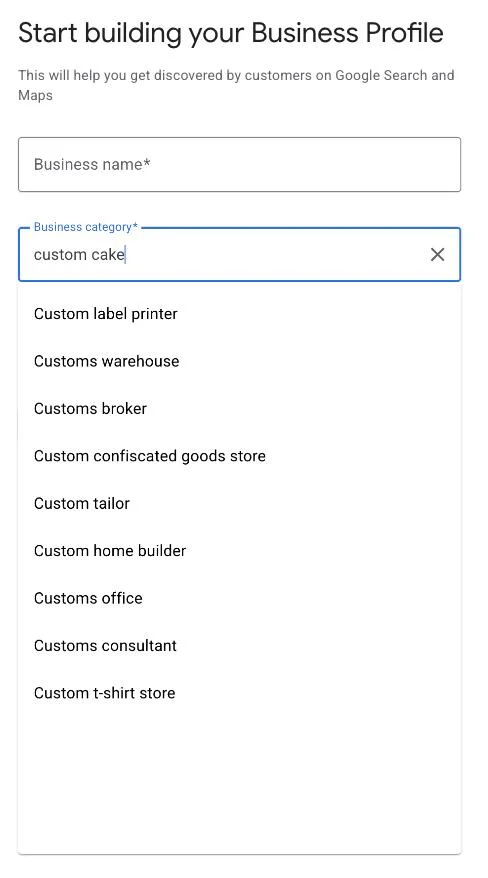
"Home bakery" is worse: exactly two categories, Chinese bakery and Wholesale bakery, with the plain "Bakery" result dropped entirely. Describing yourself accurately gets a worse answer than typing the generic word. "Cake" ranks Casket service fifth and Social worker eighth, both above Bakery in tenth. Type "bakery" and you get 15 results, only the first five of them bakery categories.
The more precisely you describe a home bakery, the fewer food categories Google offers
View data
| query | Results returned (results returned) | Bakery, cake or catering categories (results returned) |
|---|---|---|
| bakery | 15 results returned | 5 results returned |
| home bakery | 2 results returned | 2 results returned |
| cake | 15 results returned | 6 results returned |
| custom cake | 9 results returned | 0 results returned |
| cupcake | 9 results returned | 1 results returned |
| caterer | 9 results returned | 4 results returned |
The bakery-adjacent categories confirmed real, read off the live field: Bakery, Chinese bakery, Wedding bakery, Wholesale bakery, Bakery equipment, Cake shop, Cupcake shop, Rice cake shop, Cake decorating equipment shop, Dessert shop, Dessert restaurant, Frozen dessert supplier, Sweets and dessert buffet, Caterer, Mobile caterer, Catering food and drink supplier, Catering equipment rental service, Cafe and Cafeteria.
So pick Bakery or Cake shop and stop agonizing. A specific primary does not cut you out of broader searches: Google's example is a Pizza restaurant still showing for Restaurants or Pizza. Mobile caterer is the one string in the sweep that says you travel, but delivering a birthday cake does not make you a caterer, and Google's guidelines say to use as few categories as possible to describe your overall core business. Add it as a secondary only if catering is a real part of what you sell. Additional GBP Categories ranked 8th of 187, so a secondary that fits is not decoration.
Storefront or service area: what hiding your address costs
Google's rule points one way, the ranking research the other.
Google's side: a business without permanent on-site signage is not eligible as a storefront and should be a service-area business, one that visits or delivers rather than serving customers at its address. Its guidelines tell service-area businesses to hide the address, and the worked example is a plumber at a residential address who should clear it from the profile. If you deliver, that is Google describing you. If customers only collect from your door, the no-signage instruction still points you at service-area, even though Google's definition of one assumes you do not serve customers at home. No P.O. box workaround either: it requires a precise real-world address and prohibits P.O. boxes, remote mailboxes and virtual offices you do not operate from.
The other side: in the 2026 expert survey, "Address Is Showing on GBP" is the 7th highest-scored map-results factor at 176 points, and three more of the top ten are address-related: proximity to the searcher at 225, a physical address in the city of search at 213, map pin placement at 165. Hold that at arm's length: it is an opinion survey, 47 practitioners scoring 187 factors from 0 to 5, not a measurement of Google's algorithm. It is still the best evidence anyone has, and it says hiding your address costs you.
The field looks nothing like Google's rule. Maps searches for home bakeries in three Texas metros on 4 September 2026 returned only listings showing a street address, including home-based bakeries on residential streets, one of them with reviews and an "Order online" button. Three searches is an observation, not a survey. Still: your peers are publishing their home addresses, and this guide says not to.
So price it honestly. Hiding the address trades what those experts believe is ranking weight for compliance with your city code and your house staying off Maps. In San Diego, publishing it would put you against the home occupation code. I would hide it, and I would not pretend it is free.
Your category outranks anything you post: primary category 1st of 187, description keywords 171st
| Profile field | Rank of 187 |
|---|---|
| Primary GBP category | 1 |
| Business open at time of search | 5 |
| Address showing on GBP | 7 |
| Additional GBP categories | 8 |
| Recency of reviews | 11 |
| HTML NAP matching GBP NAP | 15 |
| Completeness of GBP | 16 |
| Proper hours set on GBP | 21 |
| Quantity of user-uploaded photos | 76 |
| Frequency of Google posts | 148 |
| Quantity of Google posts | 168 |
| Keywords in GBP description | 171 |
Rank out of 187 factors. Whitespark's 2026 Local Search Ranking Factors, published November 2025, 47 practitioners surveyed. Lower is more influential.
How do you hide your home address on Google?
Google's path is five steps: Business Profile, Edit profile, Location, Edit next to Business location, turn off the toggle labeled "Show business address to customers", Save. Google warns that if no service area is entered, a local area is chosen for you.
So set the areas yourself. Google allows up to 20, entered as cities, postal codes or other areas rather than a radius, and says it should not stretch more than about 2 hours' driving time from the business.
Then wait: hiding the address shows the service area instead, and edits can take up to 30 days to appear. No source we found says whether pulling an address off an established profile affects the reviews already on it. Decide before you collect reviews.
What phone number should you put on it?
Google's guidelines require a number that connects to the individual business location and is under the direct control of the business, prefer a local number over a call center line, and prohibit premium-rate numbers and numbers that redirect users elsewhere. Read that last clause before you get clever with forwarding.
On the question you actually have, Google is silent: the guidelines we fetched say nothing about mobile, VOIP or Google Voice numbers, neither permitting nor prohibiting them. Silence is not permission. The test is the one above: it rings you, you control it, it does not bounce the caller elsewhere. A second line passes on its face. So does your cell.
This used to be a softer call: customers could message you. Google removed Business Profile chat and call history in 2024, so what remains is the number on the profile, ringing while you are elbow-deep in buttercream.
Hours when you only bake on Thursdays
Google documents two hours modes: "Open with main hours", which displays your hours, and "Open with no main hours", which hides them. There is no by-appointment mode. Its guidelines instead say certain business types should not provide hours at all, including those with varied hours and those that operate only by appointment.
Google asks for regular customer-facing hours, and pickup hours are exactly that. So if you keep them, publish the hours you answer the phone and hand over orders, not the hours you bake: Saturday 9 to 11 plus weekday evenings is a schedule, and a truthful one. "Business is Open at Time of Search" ranked 5th of 187 factors, "Proper Hours Set on GBP" 21st, so those hours also do work for you. If you are appointment-only, or your availability changes week to week, take Google at its word and leave hours off. Publish no hours and you can never be open at the time of anybody's search, but a schedule invented for the ranking is worse than none.
How do you get verified with no sign on the door?
You do not get to pick your method. Google says verification methods are automatically determined and cannot be changed, and that the options depend on business type, public info, region or hours. Every complaint about forced video verification is that sentence.
A video must be at least 30 seconds, unedited, and captured live on a mobile device through the Business Profile flow. For a service-area business it must show three things: location evidence such as street signs or landmarks; business proof such as tools or products; and management proof, a service being performed or a document such as a permit, invoice or utility bill.
Google answers the no-signage case directly: a home-based service business may record landmarks and signs in its immediate neighborhood. So film the street sign at the end of your road, then your mixer, sheet pans and a tray of what you sell, then your registration. A Gold Product Expert in Google's forum gave a home-based operator close to that advice, after the operator switched to a service-area business, in a thread that was locked with no confirmation it worked. Take it as one volunteer's reading, not policy.
If you draw postcard verification, Google says most codes arrive within 14 days and expire after 30, and that you must not edit the name, address or category while you wait, or request a new code, because that invalidates the one in the mail. Google's page documents no recourse if it never arrives.
Point the profile at something that takes orders
A profile can carry custom ordering links that send customers elsewhere to place orders, shown on Search and Maps under Food ordering and Pickup and delivery. That turns a Maps listing into an order instead of an 8pm phone call. Point it at whatever takes orders for you: a Batch52 shop, a form, your own site.
Fill in the website field too. Two of Google's performance metrics depend on the fields you fill: Calls needs a phone number, Website clicks needs the link. Leave it blank and you lose the click and any way to know the profile worked.
Reviews are the part you control
Review signals carry about 20% of map-results weight in the 2026 survey, second only to Business Profile signals at about 25%. Unlike proximity, this one responds to effort.
BrightLocal's February 2026 survey of 1,002 US adults sets the target: 47% will not use a business with fewer than 20 reviews. So twenty, not five. In the same survey, 68% will only use a business rated four stars or better, and 80% say they are likely to use one that replies to all reviews. The mechanism is asking: 78% had been asked for a review, and 83% of those asked left one. Put the ask in the box, in the pickup text, in the thank-you email, every time.
Nearly half of consumers will not use a business with fewer than 20 reviews
| What US consumers say | % of respondents |
|---|---|
| Read reviews for local businesses | 97 |
| Care about star ratings | 92 |
| Left a review after being asked | 83 |
| Likely to use a business that replies to all reviews | 80 |
| Were asked to write a review | 78 |
| Seek reviews from the last three months | 74 |
| Will only use a business with 4+ stars | 68 |
| Check the business website after positive reviews | 54 |
| Won't use a business with fewer than 20 reviews | 47 |
BrightLocal Local Consumer Review Survey, February 2026, 1,002 US adults. The 83% is a share of the 78% who were asked, not of everyone surveyed.
Recency of Reviews ranked 11th of 187; Keywords in GBP Description ranked 171st. Ask three customers today.
What gets a home bakery suspended
The name field. Google requires the business name to reflect the real-world name and prohibits marketing taglines, special characters, irrelevant legal terms, and service or product information. "Yourname Bakes - Custom Cakes Austin" breaks that rule. It is also the 3rd most influential map-results factor in the 2026 survey, 223 points for Keywords in GBP Business Title, which is why bakers keep doing it. Every listing we saw in those Texas metros that appended descriptors to a real name was taking that bet.
A pinned guide in Google's forum calls a keyword-stuffed name the number one reason for suspension issues, and a Product Expert says there is no way to download your reviews out of a profile. Both are volunteer posts, not policy. The asymmetry is what matters: you would risk a year of reviews you cannot export for a boost you can get by picking the right category.
Google may suspend profiles that break its guidelines but enumerates no reasons, and the appeal asks for evidence such as business registration, a license or a utility bill. Scan your cottage food registration now, not then.
What this guide cannot tell you
We stopped at the Next button on screen one: clicking it would have accepted the Terms of Service on a real account and created a Maps entry for a bakery that does not exist. Four onboarding screens are undocumented here, including the visitable-location question. We found no hidden-address bakery in Maps to inspect either.
Sources
All URLs accessed 4 September 2026. The autocomplete results and Maps observations are ours, same day.
- New SEO Tool Tracks % Of Google SERPs With Local Packs (Search Engine Journal, March 23, 2021). https://www.searchenginejournal.com/new-seo-tool-gathers-google-search-insights-from-60m-queries/399911/
- Google My Business Insights Study (BrightLocal, published July 15, 2019; 45,000 listings, data September 2017 to December 2018). https://www.brightlocal.com/research/google-my-business-insights-study/
- Google Event: 46% Of Searches Have Local Intent (Search Engine Roundtable, October 17, 2018). https://www.seroundtable.com/google-46-of-searches-have-local-intent-26529.html
- Complete your Business Profile on Google (Google Business Profile Help). https://support.google.com/business/answer/10515606?hl=en
- Cottage Food Law Guidance (Minnesota Department of Agriculture). https://www.mda.state.mn.us/food-feed/cottage-food-law-guidance
- Cottage Food Operator FAQ (New Jersey Department of Health). https://www.nj.gov/health/cottagefood/rules-resources/faq/
- Information Bulletin 540, Neighborhood Use Permit for a Home Occupation, LDC 141.0308 (City of San Diego, July 2020). https://www.sandiego.gov/sites/default/files/dsdib540.pdf
- Murrieta, CA Municipal Code section 16.60.050, Home Occupations and Cottage Food Operations. https://codelibrary.amlegal.com/codes/murrieta/latest/murrieta_ca/0-0-0-28464
- Popular Las Vegas cottage bakery forced to halt doorstep pickups after cease and desist warning (FOX5 Vegas, August 12, 2026). https://www.fox5vegas.com/2026/08/12/viral-las-vegas-cottage-bakery-gets-cease-desist-order/
- Insuring Your Home-based Business (Insurance Information Institute). https://www.iii.org/article/insuring-your-home-based-business
- Texas Cottage Food Production (Texas Department of State Health Services). https://www.dshs.texas.gov/retail-food-establishments/texas-cottage-food-production
- Licensing Information Search (Minnesota Department of Agriculture). https://www.mda.state.mn.us/licensing/license-lookup
- Author's hands-on test, September 4, 2026: the live Google Business Profile signup flow, the category autocomplete, business.google.com/locations and Google Maps searches in three Texas metros.
- Manage your business categories (Google Business Profile Help). https://support.google.com/business/answer/7249669?hl=en
- Edit your Business Profile (Google Business Profile Help). https://support.google.com/business/answer/3039617?hl=en
- 2026 Local Search Ranking Factors (Whitespark, published November 6, 2025; 47 local search experts scoring 187 factors). https://whitespark.ca/local-search-ranking-factors/
- Manage your business address (Google Business Profile Help). https://support.google.com/business/answer/2853879
- Add or edit your service areas (Google Business Profile Help). https://support.google.com/business/answer/9157481
- Guidelines for representing your business on Google. https://support.google.com/business/answer/3038177?hl=en
- Business eligibility and ownership guidelines (Google Business Profile Help). https://support.google.com/business/answer/13763036?hl=en
- Changes to Google Business Profile chat and call history. https://support.google.com/business/answer/14919056?hl=en
- Edit your business hours (Google Business Profile Help). https://support.google.com/business/answer/15300403?hl=en
- Verify your Business Profile (Google Business Profile Help). https://support.google.com/business/answer/7107242?hl=en
- Verify your business with a video recording (Google Business Profile Help). https://support.google.com/business/answer/14271705?hl=en
- Can't complete video verification, home-based business with no signage (Google Business Profile Community thread). https://support.google.com/business/thread/358946279/can-t-complete-video-verification-%E2%80%93-home-based-business-no-signage?hl=en
- Manage online ordering options (Google Business Profile Help). https://support.google.com/business/answer/10842217?hl=en
- Business Profile performance metrics (Google Business Profile Help). https://support.google.com/business/answer/9918094?hl=en
- Local Consumer Review Survey 2026 (BrightLocal, fielded February 2026, 1,002 US adults). https://www.brightlocal.com/research/local-consumer-review-survey/
- How to Verify Your Google Business Profile, pinned Google Business Profile Community guide (last edited April 2, 2026). https://support.google.com/business/community-guide/342311022/how-to-verify-your-google-business-profile-everything-you-need-to-know-about-google-verification?hl=en-GB
- Asked to verify business through video recording, but not possible (Google Business Profile Community thread). https://support.google.com/business/thread/257073226/asked-to-verify-business-through-video-recording-but-not-possible?hl=en
- Suspended profiles and appeals (Google Business Profile Help). https://support.google.com/business/answer/4569145?hl=en
Frequently asked questions
Can I use my cell phone number on a Google Business Profile?
Google's guidelines require a number that connects to the individual business location and is under the direct control of the business, and they prohibit premium-rate numbers and numbers that redirect users elsewhere. They say nothing about mobile, VOIP or Google Voice numbers, neither permitting nor prohibiting them. A cell phone that rings you, that you control, and that does not bounce the caller elsewhere meets the test Google does state.
How long does a Google Business Profile edit take to show up?
Google says edits can take up to 30 days to appear. Hiding your address shows your service area instead, and if you enter no service area, Google chooses a local one for you. If you draw postcard verification, Google says most codes arrive within 14 days and expire after 30, and that editing the name, address or category while you wait invalidates the code already in the mail.
Does listing a cottage food bakery on Google Maps break my state's cottage food law?
Not in the two states we read. Minnesota and New Jersey both expressly permit advertising and taking orders online, and neither treats a Maps listing as a licensing trigger. What they limit is where you hand the food over: Minnesota permits the producer's home, a farmers' market and a community event, and requires the handover in person. Your city zoning code is a separate rulebook, and it is the one that decides whether customers may come to your house.

Nicholas Shiffert
Founder, Batch52
Nicholas builds Batch52, the ordering platform for home bakers and cottage food businesses. He spends most weeks talking with bakers about pickup days, pricing, and the paperwork nobody warned them about.
Research and drafting assisted by AI. Fact-checked, edited, and published by Nicholas Shiffert.