You bake sourdough in Riverside, take orders by Instagram DM, and hand boxes over on the porch on Saturday mornings. Someone in a Facebook group says Class B is for anyone serious, and three pages give you three different sales caps. I read the statute, the California Department of Public Health (CDPH) pages, and the fee schedules of the ten largest counties on September 6, 2026.
If you sell directly to your customers, you need a Class A registration, not a Class B permit. Class B is a wholesale decision, not a growth decision. And the 2026 sales cap is $88,878 for Class A, not the $75,000 that CDPH's own page still prints. The short version lives on our California state page.
Key takeaways
- Selling directly to customers, including Instagram DM orders, porch pickup, farmers' markets, and mail within California, needs only a Class A registration and no kitchen inspection. Class B is required only to sell through a permitted shop, cafe, or restaurant.
- The 2026 sales cap is $88,878 for Class A and $177,756 for Class B, effective January 1, 2026. The $75,000 and $150,000 figures still printed on the CDPH page are the 2022 base.
- Class A first-year cost in the ten largest counties runs from $118 in Los Angeles to $777 in Santa Clara, as posted September 6, 2026. Class B first year runs from $225 in Orange County to $1,225 in Santa Clara.
- Every label needs "Made in a Home Kitchen" in 12-point type, and any advertisement, including an Instagram post, must show the same statement plus your permit number and county.
- Seven of the ten largest counties list city or county zoning approval among their application requirements, so call your city planning desk first.
Class A vs Class B in one table
CDPH does not register or permit cottage food operations; your county environmental health department, which the law calls the local enforcement agency, does.
| Class A | Class B | |
|---|---|---|
| Issued by | County environmental health (registration) | County environmental health (permit) |
| Sales allowed | Direct to consumers only | Direct and indirect (through permitted retailers) |
| Before your first sale | Register and submit a self-certification checklist | Pass an initial home kitchen inspection |
| Routine inspections | None; entry only on a consumer complaint | At most once a year |
| 2026 gross sales cap | $88,878 | $177,756 |
| Where you may sell | Anywhere in California | Anywhere in California |
| Renewal | Annual, nontransferable | Annual, nontransferable |
A Class A operation may engage only in direct sales under Health and Safety Code 113758(a)(1). A Class B operation may engage in both direct and indirect sales under 113758(a)(2), so a baker who does both needs only the Class B permit. An indirect sale is a sale to the consumer through a third-party retailer holding a valid retail food facility permit, such as a shop, cafe, or restaurant.
A Class A operation may not open until it has registered with the county and submitted a self-certification checklist the county approves. It gets no routine inspection; the county may enter the kitchen only on a consumer complaint. A Class B permit number is issued only after an initial home kitchen inspection, with at most one inspection a year after that. Both classes may sell throughout California on a registration or permit from one county. Either one renews annually, cannot be transferred, and is valid only for the person, location, type of sales, and distribution activity written on it.
Six operational rules apply to every operation: no other domestic activity in the kitchen while you work, no infants, small children, or pets present, clean equipment in good repair, wash-rinse-sanitize before each use, vermin-free storage, and no smoking in the work area. You may have no more than one full-time-equivalent employee, and immediate family or household members who help do not count. All cottage food work, including storage and labeling, must happen inside the living space of the home; Ventura County's Class B requirements expressly bar the backyard, shed, garage, vehicle, or any out-building.
Which class does a porch-pickup baker need?
Class A is enough. Under Health and Safety Code 113758(b)(4), direct sales include bake sales, holiday bazaars, farm stands, certified farmers' markets, community-supported agriculture subscriptions, in-person sales at your home, and orders placed by phone, internet, or any other digital method. A direct sale may be fulfilled in person, by mail, or by any third-party delivery service, so porch pickup, shipping within California, and courier delivery are all Class A activities.
Say you sell 40 boxes a month in San Diego through DMs, do one farmers' market a month, and mail the odd care package to Sacramento. All of that is direct. You register as Class A, pay $231 the first year and $92 a year after under San Diego's schedule in force since July 11, 2026, and no inspector comes to the house. The month a coffee shop asks to stock your scones, you need Class B, which in San Diego means $526 the first year, $361 on renewal, and an initial kitchen inspection. The extra cost buys the right to sell through someone else's permitted counter.
Both classes stop at the state line. Both sale types are defined as transactions within the state, so cottage food may not be sold or shipped to customers outside California. Selling at a farmers' market, swap meet, or community event may require a separate temporary event permit from the county on top of your registration. Santa Clara's permit page, as read September 6, 2026, goes further and prohibits cottage food sales on platforms such as Amazon or Etsy, although the statute itself says nothing about online marketplaces.
In Santa Clara County, as of September 6, 2026, moving from Class A to Class B requires a new application packet plus a $423.00 facility evaluation fee under the March 1, 2026 schedule, while moving down from B to A carries no fee. Start with A. Add B when a retailer is actually asking.
The sales cap: $75,000 in the statute, $88,878 in 2026
Health and Safety Code 113758(a) sets the Class A cap at $75,000 and the Class B cap at $150,000 in verifiable gross annual sales, both adjusted annually for inflation using the California Consumer Price Index. Those base numbers are what the CDPH page and several county pages print, and they have not been the operating limit since 2022.
Effective January 1, 2026, CDPH's adjusted limit is $88,878 for Class A and $177,756 for Class B, based on a 3.1 percent CPI change for 2024 to 2025. For 2025 the limits were $86,206 and $172,411.
The Class A cap is $88,878 in 2026, not the $75,000 CDPH's own page still prints
View data
| year | Class A (USD) | Class B (USD) |
|---|---|---|
| 2022 | $75,000 | $150,000 |
| 2023 | $80,475 | $160,950 |
| 2024 | $83,614 | $167,227 |
| 2025 | $86,206 | $172,411 |
| 2026 | $88,878 | $177,756 |
CDPH's own Cottage Food Operations page, last updated May 14, 2026, still prints $75,000 and $150,000 as the current maximums while linking the separate 2026 adjusted-limit PDF. Several county pages repeat the same figures. The correct number is one click deeper, and the PDF is the document to keep.
The cap is a cliff, not a tax bracket. Exceeding it ends your cottage food status; county application forms make you attest that you would then have to move to a permitted commercial facility. Before January 1, 2022, all operations shared a single $50,000 cap and Class B sales were limited to the county that issued the permit.
Training: any ANSI food handler course within three months
Health and Safety Code 114365.2(d) requires anyone who prepares or packages cottage food to complete a CDPH-approved food processor course of no more than four hours within three months of registration and every three years after. CDPH satisfies this with any ANSI-accredited California food handler course; the operator, any employee, and any household member who helps must each take it, keep the card as proof, and repeat it every three years.
Two counties override the state's course choice. San Bernardino County accepts only its own county food handler certification, and Riverside County requires proof of the Riverside County Food Handler Course within one week of approval.
The label and the Instagram rule
Health and Safety Code 114365.2(e) requires every label to carry "Made in a Home Kitchen" in 12-point type on the primary display panel, the common name of the food, the name of your operation, your registration or permit number with the issuing county, and the ingredients in descending order by weight. Because the statute also requires compliance with the federal Food, Drug, and Cosmetic Act, county label checklists add a net quantity in both English and metric units and a plain-language declaration of the major allergens, which Ventura County's checklist spells out as nine, including sesame.
The rule follows you off the package. Under Health and Safety Code 114365.2(f), any advertisement, including a website or a social media post, must show the county of approval, the permit or registration number, and the statement "Made in a Home Kitchen." That means your Instagram bio, your menu-drop post, and your shop page. On a Batch52 shop, the announcement banner is the natural place for it.
If you print a date, a second law applies. From July 1, 2026, AB 660 requires a quality or safety date printed on a food label sold in California to use "BEST if Used by" or "BEST if Used or Frozen by" wording for quality, or "USE by" or "USE by or Freeze by" for safety, and bans "sell by"; cottage food labels are not required to carry a date, so this applies only if you choose to print one. The bill does not name cottage food, so that is the safe reading, not a settled one.
Counties typically review up to ten product labels with the initial application and charge an hourly or per-submittal fee for each label added later, so in most counties a new product sold before its label is approved is both a violation and a bill. Submit your full first-year menu with the application, seasonal flavors included.
What you can make, and the foods counties refuse
A cottage food product may not be a potentially hazardous food; Health and Safety Code 114365.5 lists 16 statutory categories, and CDPH may add or remove foods with a posted notice that takes effect 30 days later. As posted on September 6, 2026, CDPH's Approved Cottage Foods list allows pies only if fruit-filled and expressly excludes pumpkin, allows empanadas, samosas, and tamales only with fruit fillings, allows macarons only with approved fillings, and allows marshmallows only without eggs.
Eggs catch people. They are allowed in baked goods that are dry once baked, such as cookies and cakes, but not in custards or lemon curd, and Ventura County's product checklist bars frostings containing eggs, cream, or cream cheese unless the egg is meringue powder, powdered egg, or pasteurized egg. Contra Costa County's FAQ, for example, refuses salsa, pickles, hot sauce and other canned foods, pumpkin and sweet potato pie, and lemon curd, and the Sustainable Economies Law Center adds cheesecake, flan, and lemon meringue pie, all because they are potentially hazardous or need refrigeration. If pumpkin pie is your Thanksgiving bestseller, this is not the program for it.
How much does a California cottage food permit cost?
Class A first-year cost varies more than sixfold across the ten counties, from $118 to $777. Every number below comes from the county's own fee document as posted on September 6, 2026, with the date the document carries. Santa Clara and Fresno charge a one-time fee on top of the annual one, which is why their first year and renewal differ. Where a county prints a single annual amount, the two columns match.
| County | Class A first year | Class A renewal | Class B first year | Class B renewal | Date on the document | Source |
|---|---|---|---|---|---|---|
| Los Angeles | $118 | $118 | $292 | $292 | Effective August 8, 2013 | Class A, Class B |
| San Diego | $231 | $92 | $526 | $361 | Effective July 11, 2026 | Fee page |
| Orange | $225 | $128 | $225 | $384 | July 1, 2025 to June 30, 2026 | Program page |
| Riverside | $205 | $205 | $394 | $394 | Valid to June 30, 2026; nothing newer posted | Form DES-258 |
| San Bernardino | $229 | $229 | $311 | $311 | Data date June 30, 2026 | Fee schedule |
| Santa Clara | $777 | $284 | $1,225 | $732 | March 1, 2026; rises September 15, 2026 | Fee schedule |
| Alameda | $190 | $190 | $450 | $450 | Labeled effective July 1, 2021 | General fees |
| Sacramento | $306 | $306 | $528 | $528 | No date on page | Program page |
| Contra Costa | $331 | $194 | $343 | $335 | Undated; A renewal $194 through 2026 | Scheduled fees |
| Fresno | $508 | $172 | $485 | $149 | Effective April 1, 2026 | Master fee schedule |
Orange County's program page lists, for July 1, 2025 to June 30, 2026, a $225 initial review for up to 10 labels in either class, a $128 Class A renewal, a $384 Class B renewal, and product additions at $128 per hour. The fee schedule PDF it links shows $221, $125, and $376 for the same lines. I used the page figures because the page is what an applicant sees.
Santa Clara is the expensive one, and it is about to get more so. Under the schedule effective March 1, 2026, a new operator pays a $493.00 application fee plus an annual fee of $284.00 for Class A or $732.00 for Class B, a first-year total of $777.00 or $1,225.00; renewal is the annual fee alone. The schedule effective September 15, 2026 raises the application fee to $508.00, Class A to $293.00, and Class B to $754.00, making the first year $801.00 or $1,262.00.
Contra Costa charges $331 for a Class A application packet review, $343 for a Class B packet review and inspection, and $335 for Class B renewal. The Class A renewal is the row I trust least. The county's schedule lists it at $194 in a phased column that runs through December 31, 2026 and $279 from January 1, 2027, and separately lists an $87 non-refundable application fee without saying whether it is added to the packet review. Call the county before you budget that one.
Fresno's master fee schedule effective April 1, 2026 charges a one-time $336 plan check plus $172 per year for Class A and $149 per year for Class B, with menu revisions at $65 per submittal, so Class B costs less per year than Class A. Both Fresno documents agree. It is still worth a call before you choose a class on price.
Late renewal has a posted price in at least four counties. Riverside adds 20 percent to a permit not renewed by its expiration date, rising to 100 percent after 30 days. San Bernardino charges 25 percent after 30 days late, and its permits renew automatically and are billed annually unless you report closure. Alameda's penalties reach 50 percent. Santa Clara adds 25 percent if the annual fee is unpaid at expiration. Santa Clara and Sacramento exempt qualified veterans from the permit fee; in Santa Clara the application fee is still owed.
What your county adds beyond state law
The state law is the same everywhere. The county paperwork is not. Seven of the ten largest counties (San Bernardino, Riverside, Santa Clara, Alameda, Sacramento, Contra Costa, Fresno) list city or county planning or zoning approval, such as a home occupation permit or zone clearance, among their application requirements; the Los Angeles and Orange County pages I read do not mention one, so ask your city. Santa Clara County's permit page, as read September 6, 2026, says it will not issue a cottage food permit to an LLC, corporation, or partnership, and quotes up to 20 days for initial review.
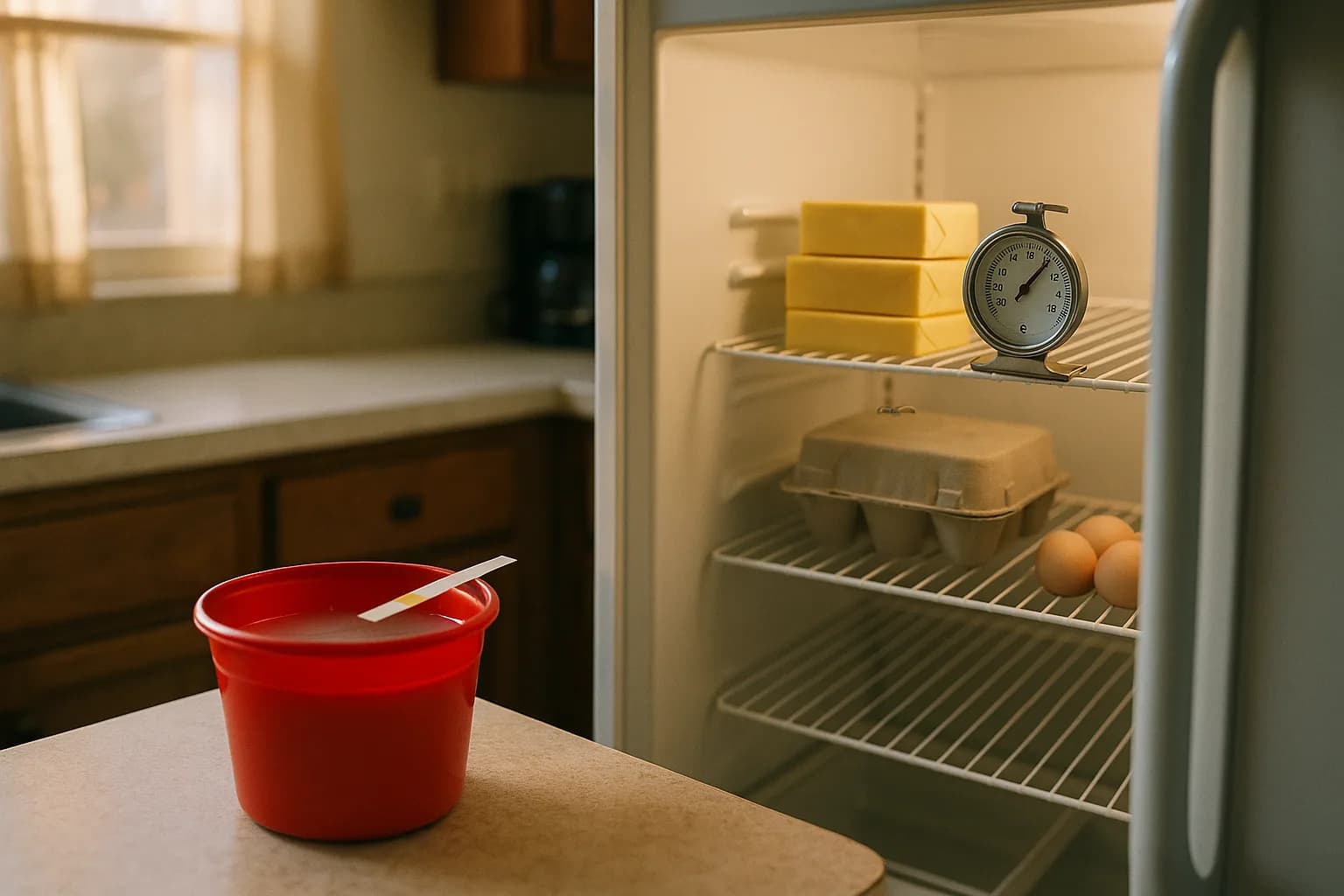
If you go Class B, the inspection has numbers. Ventura County's standard requires a chlorine sanitizer of 100 ppm (one tablespoon of unscented bleach per gallon) with 30 seconds of contact or a dishwasher reaching 160 F, refrigeration of hazardous ingredients at or below 41 F with a thermometer in each unit, and hot water of at least 120 F. Ventura is not a top-ten county, but its checklist is the most detailed one I found.
Common mistakes
Orange County's list of common mistakes to avoid includes adding products without prior approval, moving without reapplying, selling from an event booth without its own permit, skipping items on the sample label, and unapproved products such as pickles, sandwiches, BBQ sauce, and jams with peppers. County application forms require you to notify the county before changing your food list, your type of operation, or your method of selling or distributing, whether sold, consigned, or given away. In most counties, a new flavor on Saturday's menu that is not on your approved label list is a violation and an added-label fee at once.
The other trap is trusting the county page over the statute. Several still describe Class B indirect sales as limited to the home county or as needing the other county's approval, wording that predates the statewide authorization effective January 1, 2022; the statute controls. Keep a copy of Health and Safety Code 114365 handy.
Cottage food or MEHKO
If your menu is hot food, California has a second program. A Microenterprise Home Kitchen Operation (MEHKO) under Health and Safety Code 113825 is a home restaurant that prepares, cooks, and serves food the same day, limited to 30 meals a day, 90 meals a week, and $100,000 in CPI-adjusted gross annual sales, selling only directly to consumers. The statute appears to exclude a cottage food operation from the MEHKO definition, and Contra Costa County, as county policy, allows a private residence to run only one type of home-based food business.
As posted September 6, 2026, MEHKO permits cost more than cottage food permits: $673 initial and $335 renewal in San Diego, $659 in Riverside, $696 in Alameda, $732 in Santa Clara under the March 1, 2026 schedule, and $847 initial in Contra Costa's current-fee column. MEHKO is county opt-in today; AB 2315, amended in the Assembly on March 19, 2026 and still pending as of September 6, 2026, would require every local enforcement agency to offer MEHKO permits by July 1, 2027. For a baker selling cookies and loaves, none of this applies. For pork tamales, it is the only legal path from a home kitchen.
What changed and what is pending
AB 1144, signed September 16, 2021 and operative January 1, 2022, raised the caps to $75,000 for Class A and $150,000 for Class B with annual CPI adjustment, authorized both classes to sell throughout the state, and required Class B permits to renew annually. That law is why out-of-date pages are wrong in the same two ways.
As of September 6, 2026, I found no bill in the 2025-2026 session that amends the cottage food statutes; the most recent amendments to Health and Safety Code 113758 and 114365.2 are AB 1144 and AB 831, both effective January 1, 2022. The two live changes nearby are AB 660's date-label wording from July 1, 2026 and AB 2315 for MEHKO.
The Sustainable Economies Law Center says liability insurance is not required, and recommends it because homeowner's policies typically exclude home-based businesses. Call your city planning desk before the county, because in seven of the ten largest counties the zoning letter is on the application checklist. We keep the California state page updated as counties post new schedules.
Sources
- Cottage Food Operations, CDPH Food and Drug Branch (Page Last Updated May 14, 2026). https://www.cdph.ca.gov/Programs/CEH/DFDCS/Pages/FDBPrograms/FoodSafetyProgram/CottageFoodOperations.aspx
- Cottage Food Operation Requirements, CDPH (Page Last Updated January 14, 2025). https://www.cdph.ca.gov/Programs/CEH/DFDCS/Pages/FDBPrograms/FoodSafetyProgram/CFORequirements.aspx
- Health and Safety Code 113758 (definitions: cottage food operation, Class A, Class B, direct and indirect sale, caps). https://leginfo.legislature.ca.gov/faces/codes_displaySection.xhtml?lawCode=HSC§ionNum=113758
- CA Cottage Food Law FAQs, Sustainable Economies Law Center (page marked no longer being updated). https://www.theselc.org/cottage_food_law_faq
- Health and Safety Code 114365 (Class A registration and checklist; Class B permit and inspection; statewide sales; annual renewal). https://leginfo.legislature.ca.gov/faces/codes_displaySection.xhtml?lawCode=HSC§ionNum=114365
- Cottage Food Operations: Class B Direct and Indirect Sales Requirements, County of Ventura Environmental Health Division, Revised October 1, 2025 (PDF). https://rmadocs.venturacounty.gov/environmental-health/programs/consumer-food-protection/forms/environmental-health-cottage-food-operations-class-b-direct-indirect-sales-requirements-application.pdf
- Food Facility Permit Fees, San Diego County DEHQ (fees effective July 11, 2026). https://www.sandiegocounty.gov/content/sdc/deh/doing_business/Fees_Food_Facility.html
- California - Cottage Food Law, Forrager (page dated 2023-09-14; limits shown as 2025 figures). https://forrager.com/law/california/
- Apply for a cottage food operator (CFO) permit, Santa Clara County DEH. https://deh.santaclaracounty.gov/food-and-retail/compliance-retail-food-operations/apply-cottage-food-operator-cfo-permit
- HOME KITCHENS (MEHKO and CFO), Contra Costa Health. https://www.cchealth.org/about-contra-costa-health/divisions/environmental-health/home-kitchens
- San Bernardino County EHS, Cottage Food Operations (CFO) FAQ, 03/2026 (PDF). https://ehs.sbcounty.gov/wp-content/uploads/sites/97/Programs/Food/CottageFoodOps/cottage-food-operations-faq.pdf
- Santa Clara County Environmental Health Fee Schedule, Effective March 1, 2026 (PDF). https://files.santaclaracounty.gov/exjcpb1761/2026-04/cpd_hazmat-combined-fee-schedule-april-2026-002.pdf?VersionId=8cRMdHjXxDqog96.JMjLJJdk3Si2pcCO
- Cottage Food Operation Adjusted Gross Annual Sales Limit 2026, CDPH (PDF). https://www.cdph.ca.gov/Programs/CEH/DFDCS/CDPH%20Document%20Library/FDB/FoodSafetyProgram/CottageFood/CFOAdjustedGrossAnnualSalesLimit2026.pdf
- Riverside County DEH, Cottage Food Operation (CFO) Registration / Permitting Form, DES-03 (REV 1/22) (PDF). https://rivcoeh.org/sites/g/files/aldnop361/files/migrated/Portals-0-PDF-Foods-CFO-Registration-Permitting-Form.pdf
- FAQs: Environmental Health - Cottage Food, Nevada County (23 questions). https://www.nevadacountyca.gov/m/faq?cat=120
- Bill Text - AB-1144 Cottage food operations (Chapter 178, Stats. 2021). https://leginfo.legislature.ca.gov/faces/billTextClient.xhtml?bill_id=202120220AB1144
- Health and Safety Code 114365.2 (sanitation, training, labels, advertising). https://leginfo.legislature.ca.gov/faces/codes_displaySection.xhtml?lawCode=HSC§ionNum=114365.2
- Cottage Food Operator Training, CDPH (Page Last Updated January 16, 2025). https://www.cdph.ca.gov/Programs/CEH/DFDCS/Pages/FDBPrograms/FoodSafetyProgram/CFOperatorTraining.aspx
- Bill Text - AB-660 Food labeling: quality dates, safety dates, and sell by dates (Chapter 911, Stats. 2024). https://leginfo.legislature.ca.gov/faces/billTextClient.xhtml?bill_id=202320240AB660
- Cottage Food Operations (CFO), OC Health Care Agency, Environmental Health. https://www.ochealthinfo.com/services-programs/environmental-health/food-safety-programs/cottage-food
- Health and Safety Code 114365.5 (approved food products list). https://leginfo.legislature.ca.gov/faces/codes_displaySection.xhtml?lawCode=HSC§ionNum=114365.5
- Approved Cottage Foods list, CDPH (PDF, 3 pages; page 1 read). https://www.cdph.ca.gov/Programs/CEH/DFDCS/CDPH%20Document%20Library/FDB/FoodSafetyProgram/CottageFood/ApprovedCottageFoodsList.pdf
- Class A Cottage Food Operators, Los Angeles County Department of Public Health, Environmental Health. http://publichealth.lacounty.gov/eh/business/class-a-cottage-food-operators.htm
- Class B Cottage Food Operators, Los Angeles County Department of Public Health, Environmental Health. http://publichealth.lacounty.gov/eh/business/class-b-cottage-food-operators.htm
- Riverside County DEH, Application / Registration to Operate a Food Facility, DES-258 (REV 6/25), Valid 7/1/25 to 6/30/26 (PDF). https://rivcoeh.org/sites/g/files/aldnop361/files/users/user141/Food-Facility-Application%20Registration%206-23-25.pdf
- Cottage Food Operations, Riverside County DEH program page. https://rivcoeh.org/cottage-food-operations
- San Bernardino County Public Health, Environmental Health Services, Fee Schedule, Data Date 6/30/2026 (PDF). https://ehs.sbcounty.gov/wp-content/uploads/sites/97/Documents/EHS_Fee_Schedule.pdf
- General Fees, Exhibit A: Alameda County Environmental Health Department Fee Schedule. https://health.alamedacountyca.gov/general-fees-eh/
- Billing, Fees, Permits, Alameda County Environmental Health Department. https://health.alamedacountyca.gov/billing-fees-permits/
- Cottage Food Operation, Sacramento County Environmental Management Department. https://emd.saccounty.gov/us/en/environmental-health/retail-food-protection-program/cottage-food-operation.html
- Scheduled Fees, Contra Costa Health Environmental Health (phased increases through 2028). https://www.cchealth.org/about-contra-costa-health/divisions/environmental-health/scheduled-fees
- Master Schedule of Fees, Charges, and Recovered Costs, Section 900 Environmental Health (effective 4/1/2026), County of Fresno (PDF). https://www.fresnocountyca.gov/files/assets/county/v/3/public-health/environmental-health/master-schedule-of-fees-eh-apr-1-26.pdf
- Cottage Food Operations, County of Fresno. https://www.fresnocountyca.gov/Departments/Public-Health/Environmental-Health/Consumer-Food-Program/Cottage-Food-Operations
- HCA Environmental Health Division, Food, Pool and Other Services FY 25-26 Fee Schedule (PDF). https://ochealthinfo.com/sites/healthcare/files/2025-08/HCA_EH_Fees_Food_and_Pool_08_2025.pdf
- Santa Clara County Environmental Health Fee Schedule, Effective September 15, 2026 (PDF). https://files.santaclaracounty.gov/exjcpb1761/2026-08/feeschedule-fy27.pdf?VersionId=pdrugGQp6Ym3VOEwp.iCDVjVBLsxxKDc
- Cottage Food Operation (CFO), Alameda County Environmental Health Department. https://health.alamedacountyca.gov/program/cottage-food-operation-cfo/
- CFO Registration / Permitting Form (2019-9-19), County of Fresno Environmental Health Division (PDF). https://www.fresnocountyca.gov/files/assets/county/v/2/public-health/environmental-health/food-safety/2019-9-19-cfo-registration-form-fresno.pdf
- Health and Safety Code 113825 (microenterprise home kitchen operation definition). https://leginfo.legislature.ca.gov/faces/codes_displaySection.xhtml?lawCode=HSC§ionNum=113825
- AB-2315 Microenterprise home kitchen operations (2025-2026 session), amended March 19, 2026. https://leginfo.legislature.ca.gov/faces/billTextClient.xhtml?bill_id=202520260AB2315
Frequently asked questions
Can a California cottage food operation ship or sell to customers outside California?
No. Both direct and indirect sales are defined in Health and Safety Code 113758 as transactions within the state, so cottage food may not be sold or shipped to customers outside California. Shipping within California to a consumer is a direct sale and is allowed under a Class A registration.
Do I need a separate permit to sell cottage food at a farmers' market in California?
Possibly. Selling at a certified farmers' market is a direct sale covered by your Class A registration or Class B permit, but selling at a farmers' market, swap meet, or community event may require a separate temporary event permit from the county on top of your registration. Ask the county that issued your registration and the market organizer.
Can I sell California cottage food on Etsy or Amazon?
The statute says nothing about online marketplaces, and orders placed by internet or any other digital method are direct sales under Health and Safety Code 113758(b)(4). Santa Clara County's permit page goes further and prohibits cottage food sales on platforms such as Amazon or Etsy, so check your own county's application rules before listing.
Can I hire help in a California cottage food operation?
Yes, within a limit. A cottage food operation may have no more than one full-time-equivalent employee, and immediate family or household members who help do not count toward that limit. Anyone who prepares or packages cottage food, including helping family members and employees, must complete the food processor course within three months and every three years after.
Is liability insurance required for a California cottage food operation?
Not by the state cottage food law, according to the Sustainable Economies Law Center, which recommends carrying it anyway because homeowner's policies typically exclude home-based businesses.

Nicholas Shiffert
Founder, Batch52
Nicholas builds Batch52, the ordering platform for home bakers and cottage food businesses. He spends most weeks talking with bakers about pickup days, pricing, and the paperwork nobody warned them about.
Research and drafting assisted by AI. Fact-checked, edited, and published by Nicholas Shiffert.