You bake in your kitchen in Lakeland, people keep asking to buy, and a Facebook group has given you four different answers about what Florida requires first. Someone said you need a license. Someone else said you can make $250,000 without one. Both are half right, which is worse than being wrong.
Here is the law as I read it on September 6, 2026, from the statute and the Florida Department of Agriculture and Consumer Services (FDACS) page. Florida asks almost nothing of a home baker: no permit, no inspection unless someone complains, no registration, and a $250,000 annual cap that few operations approach. What can still get you in trouble is the label, sales tax on candy, and a county code officer who decides your front-yard stand is retail. The short version is on our Florida state page.
Key takeaways
- Florida requires no FDACS permit, license, registration, or routine inspection for a cottage food operation. FDACS may enter and inspect only after receiving a complaint.
- The cap is $250,000 in annual gross sales of cottage food products at any location, in force since July 1, 2021. In a survey cited by the state in 2021, 17 of 548 operations reported sales between $50,000 and $250,000.
- Every product carries a label with 7 statutory elements, including the exact statement "Made in a cottage food operation that is not subject to Florida's food safety regulations" in at least 10-point type and your home street address, not a P.O. box.
- Cold bakery products are exempt from Florida sales tax. Candy and confections are taxable at the 6 percent state rate plus any county surtax, and you register with the Department of Revenue before the first taxable sale.
- State law preempts local cottage food rules but requires compliance with the home-based business statute, s. 559.955. Two Panhandle bakers lost their yard stands to county and city code enforcement in summer 2026.
Florida cottage food law in one paragraph (as of September 6, 2026)
Fla. Stat. 500.80(1)(a) exempts a cottage food operation from the permitting requirements of s. 500.12, as long as the operation complies with the section and its annual gross sales of cottage food products do not exceed $250,000. The live FDACS cottage food page, read the same day, says operators can sell directly to consumers without obtaining a food permit from FDACS, and that gross sales must not exceed $250,000 annually. FDACS's own 2021 guidance and UF/IFAS Extension put it more bluntly: no license or permit from FDACS, and no inspection by any state government entity. By statute, FDACS may enter and inspect a cottage food operation's premises "only upon receipt of a complaint." There is no registration, so the state keeps no list or count of cottage food operations, a gap Florida's own Revenue Estimating Conference noted in 2021.
Where the rules live, and why guides disagree
Three documents govern Florida cottage food. The statute, Fla. Stat. 500.80, is the law. The live FDACS page is thin. On September 6, 2026, it held a 12-item list of approved foods and a few sentences, with no prohibited-foods list, no labeling section, no linked PDF or FAQ, and no last-updated date; the only date on the page was the footer "©2026."
The detailed guidance is gone from public view. FDACS's cottage food guidance PDF (FDACS-P-02072, revised July 2021) was captured by the Wayback Machine 13 times between October 14, 2021 and January 7, 2026, and on September 6, 2026 its fdacs.gov address redirected to a login page. A guide that quotes a prohibited-foods list or a labeling FAQ is most likely drawing on this PDF, whether it says so or not. I cite it below as FDACS guidance, July 2021, archived copy.
Who qualifies as a Florida cottage food operation?
Fla. Stat. 500.03(1)(i) defines a cottage food operation as a natural person or an entity that produces or packages cottage food products at the residence of the natural person, or at the residence of a natural person who has an ownership interest in the entity. An LLC qualifies, as long as an owner's home is the kitchen.
The kitchen has to be yours. FDACS guidance (July 2021, archived copy) says cottage food can only be made in the kitchen of your home, not a rented or commercial kitchen, and bars storing ingredients or products in a garage, shed, barn, or other outbuilding; the statute itself, at 500.80(4), lets you sell only products stored on the operation's premises.
What can you sell under Florida's cottage food law?
12 categories, none of them refrigerated. On September 6, 2026 the live FDACS page listed 12 approved categories: loaf breads, rolls, biscuits; cakes, pastries and cookies; candies and confections; honey; jams, jellies and preserves; fruit pies and dried fruits; dry herbs, seasonings and mixtures; homemade pasta; cereals, trail mixes and granola; coated or uncoated nuts; vinegar and flavored vinegars; popcorn and popcorn balls.
The archived July 2021 guidance listed 13, the extra one being nut butters (almond, peanut, cashew and the like), and it qualified the jams entry as high-acid fruits only. If nut butter is your product, ask FDACS before you print labels.
What you cannot sell
The test is the statutory definition. In its 2026 wording, a cottage food product is food that is not time or temperature controlled for safety or a potentially hazardous food as defined by department rule. Chapter 2025-22 (SB 700), effective July 1, 2025, added the words "time or temperature controlled for safety" to that definition and made no substantive change to s. 500.80.
FDACS's list that applies the test lives only in the archived guidance. FDACS guidance (July 2021, archived copy) prohibits, among other items, salsas and sauces, canned or pickled products, fish and shellfish, raw sprouts, eggs and dairy, cut fresh fruit and fresh juices, meat and jerky, focaccia with vegetables or cheese, hemp or CBD products, and any bakery good that requires refrigeration such as cream, custard, or meringue pies.
The frosting rule catches the most bakers. The same guidance says cream cheese and real-butter icings are not allowed because they require refrigeration, while margarine, shortening, and vegan butter icings are permissible. Pet treats are out too: FDACS guidance and UF/IFAS Extension both say the cottage food rules apply to human food only.
If your product needs the fridge to stay safe, it is not cottage food in Florida.
Where and how you can sell
Fla. Stat. 500.80(2) lets a cottage food operation sell and accept payment over the Internet or by mail order, and deliver in person to the consumer, to a specific event venue, or by United States Postal Service or commercial mail delivery service.
The same subsection bars selling, offering for sale, or delivering cottage food products at wholesale, and the live FDACS page repeats that cottage food cannot be sold wholesale. FDACS guidance (July 2021, archived copy) spells out what that excludes: no pickup or distribution by a third party, no consignment, and no sales to restaurants or grocery stores, because those count as wholesale. On that reading, a delivery-app courier is a third party.
The 2021 guidance approves sales at farmers markets, flea markets, and roadside stands provided no other food in your space requires a food permit, and both FDACS and UF/IFAS note that a market or venue may still require vendors to hold a food license of its own.
Can you ship out of state?
Florida law does not say. Neither Fla. Stat. 500.80, the live FDACS page, nor the archived 2021 guidance contains any language restricting mail-order shipments to Florida addresses or addressing out-of-state shipping at all.
UF/IFAS Extension's FS425 publication, the UF/IFAS Lee County 2022 update, and the Institute for Justice's Florida page each read that silence as permission, stating that Florida cottage food products may be shipped across state lines. Pages claiming shipments must stay in Florida point to no line in the statute, because there is none. Before you ship a box to Georgia, read Georgia's rule.
The label, verbatim
Fla. Stat. 500.80(3) requires every cottage food product to be prepackaged with an affixed label showing the name and address of the operation, the name of the product, the ingredients in descending order of predominance by weight, the net weight or net volume, allergen information as specified by federal labeling requirements, and nutritional information if any nutritional claim is made.
Section 500.80(3)(g) requires that exact statement, printed in at least 10-point type in a color that clearly contrasts with the label background.
Address means your home. FDACS guidance (July 2021, archived copy) requires the physical address of the home kitchen on the label rather than a post office box, for recall and traceback purposes, and Florida sellers posting in August 2026 report following that rule.
Allergens means nine. Federal law recognizes nine major food allergens: the eight named by FALCPA in 2004 (milk, eggs, fish, Crustacean shellfish, tree nuts, peanuts, wheat, and soybeans) plus sesame, which the FASTER Act made the ninth effective January 1, 2023. FDACS's own 2021 guidance and UF/IFAS FS425 still cover only the original eight, without sesame, while the UF/IFAS Lee County 2022 update adds sesame. Because 500.80(3)(e) defers to federal law, nine is the number.
Cakes get an exception. For cakes that are not easily packaged, the 2021 guidance requires all label information on the invoice delivered with the cake, or on the box if the cake is boxed.
The $250,000 cap
The cap is on gross sales, not profit, and it is annual. Under 500.80(1)(b), annual gross sales include all sales of cottage food products at any location, regardless of the types of products sold or the number of persons involved in the operation, and the operation must give FDACS written documentation to verify those sales on request. The statute does not say calendar year or rolling twelve months, so treat any twelve-month window as the test.
The number gets misread. A March 2024 r/florida thread shows a newcomer reading the $250,000 figure as permission to earn $250,000 without permits, and being corrected that it is a ceiling on gross sales. Above the ceiling you need an FDACS food permit like any other bakery.
Almost nobody gets there. In an Institute for Justice survey cited by Florida's 2021 Revenue Estimating Conference, 17 of 548 responding cottage food operations, 3 percent, reported annual sales between $50,000 and $250,000. Florida's $250,000 was tied for the highest cap in the country when the Institute for Justice counted 25 states with caps ranging from $3,000 to $250,000 in March 2022. The figure has stood since July 1, 2021, and the 2025 session left it alone.
The $250,000 cap is a 2021 number that 2025 left alone
View data
| year | Annual gross sales cap (USD) |
|---|---|
| 2011 | $15,000 |
| 2017 | $50,000 |
| 2021 | $250,000 |
| 2025 | $250,000 |
Sales tax: cookies are exempt, candy is not
Tax is a separate question from permits. Section 500.80(5) says the section does not exempt an operation from any state or federal tax law, rule, regulation, or certificate.
Under Rule 12A-1.011(3)(d), Florida Administrative Code, and the Department of Revenue's Form DR-46NT, bakery products sold by bakeries, pastry shops, or like establishments that do not have eating facilities are exempt from sales tax, except items sold as hot prepared food. A cold cookie or a loaf of bread: exempt.
Under Rule 12A-1.011(4)(a) and the same form, candy, confections, and similar products regarded as candy based on their label or advertising are taxable. So the fudge on your table is taxable while the cookies beside it are not. The same rule taxes food sold through a push cart, motor vehicle, or vending machine, and food prepared and sold for immediate consumption, with an exception for food prepared off the seller's premises and sold in its original sealed container.
The Department of Revenue's registration page, read September 6, 2026, requires a business that will sell taxable goods or services to register as a sales and use tax dealer before it begins business, through the online Florida Business Tax Application or paper Form DR-1, and the online wizard decides whether you need to register. Florida's general state rate is 6 percent, and many counties add a discretionary sales surtax. If you sell only exempt baked goods, run the wizard anyway and keep the result.
Local rules that survive preemption
Fla. Stat. 500.80(6) preempts regulation of cottage food operations to the state, bars any local law from prohibiting an operation or regulating preparation, processing, storage, or sale, and then adds one condition: the operation must comply with the home-based business conditions of s. 559.955. That cross-reference is where Florida bakers get shut down.
Under 559.955(2), a home-based business may operate in an area zoned for residential use and is subject locally only to the business taxes of chapter 205 in its county and municipality.
Section 559.955(3)(c) requires that, as viewed from the street, the residential property's use be consistent with the surrounding residential area, and it bars a home-based business from conducting retail transactions at a structure other than the residential dwelling. Section 559.955(3)(e) requires compliance with relevant local or state signage regulations and with local nuisance rules on noise, smoke, odors, and similar effects. And 559.955(5)(a) says the home-based business protections do not supersede condominium, cooperative, or homeowners association declarations adopted under chapters 718, 719, or 720.
Two Panhandle cases in summer 2026 show where the line falls. In a story updated August 5, 2026, WEAR-TV reported that Santa Rosa County told a home bakery that under its 2021 ordinance aligned with s. 559.955, cottage food home occupations may not maintain outdoor sales stands or retail displays at residential properties; the baker removed the displays and moved to online sales only. Get The Coast reported on August 3, 2026 that Fort Walton Beach code enforcement shut down the Austin's Cookies home stand after a July 22, 2026 complaint, and that the city proposed Ordinance 2227 to allow qualifying cottage food businesses one cart or stand of up to 20 square feet and 8 feet tall. Treat that ordinance as proposed; I do not know how the city voted.
On that reading, a paid preorder handed over at your front door is a transaction at the dwelling, and a canopy, a refrigerator, and a yard sign in the front yard is not. If your HOA covenants ban business activity, the statute does not rescue you.
Insurance and paperwork
Fla. Stat. 500.80 contains no insurance requirement for cottage food operations.
FLIP (Food Liability Insurance Program) cottage food insurance starts at $25.92 per month or $299 per year with no liability deductible, and Insurance Canopy sells the same policy at the same price.
| Coverage at the $299 per year starting price | Limit (USD) |
|---|---|
| General liability, each occurrence | $1,000,000 |
| General liability aggregate | $2,000,000 |
| Products-completed operations aggregate | $2,000,000 |
| Personal and advertising injury | $1,000,000 |
Two secondary guides say most Florida farmers markets require vendors to carry at least $1,000,000 in general liability insurance with a certificate naming the market as additional insured, but I did not find any market's written rule, so ask yours before you buy.
Florida's Division of Corporations charges $50.00 to register a fictitious name, the registration is valid for 5 years, and it is not required when an individual does business under their own legal name.
The alternative is a permitted bakery. Under the 2021 FDACS fee schedule cited by the Revenue Estimating Conference, a retail bakery paid a $355 annual food permit fee plus a $10 environmental health surcharge. That figure is from 2021, so confirm the current fee with FDACS. Everything else on this list is optional or one-time.
The state charges a Florida cottage food operation $0 to start
View data
| item | Cost (USD) |
|---|---|
| FDACS cottage food permit or license | $0 |
| Fictitious name registration (Sunbiz) | $50 |
| FLIP cottage food liability insurance | $299 |
| FDACS retail bakery permit (the alternative, 2021 schedule) | $365 |
Enforcement in practice
Inspection is complaint-driven by statute; FDACS may enter and inspect only upon receipt of a complaint. Refusing entry after a complaint is grounds for disciplinary action under s. 500.121. That section authorizes FDACS to impose administrative fines against a cottage food operation that violates the Florida Food Safety Act.
The record of its use is thin. In 2016, FDACS received one complaint against a cottage food operation, and there was insufficient evidence to investigate it, according to a March 16, 2017 department email cited in the House staff analysis of HB 1233. I found no public record of an FDACS fine against a cottage food operation as of September 6, 2026. In the two 2026 cases I found, the enforcement came from county and city code officers under 559.955, not from FDACS.
How the law got here
| Session law | Effective | Cap | What changed |
|---|---|---|---|
| Ch. 2011-205 (CS/HB 7209) | July 1, 2011 | $15,000 | Created s. 500.80; banned Internet, mail-order, and wholesale sales |
| Ch. 2017-32 (HB 1233) | July 1, 2017 | $50,000 | Internet sales allowed with in-person delivery to the consumer or an event venue |
| Ch. 2021-211 (CS/HB 663, Home Sweet Home Act) | July 1, 2021 | $250,000 | USPS and carrier delivery; entities and business partners; state preemption subject to s. 559.955 |
| Ch. 2025-22 (SB 700) | July 1, 2025 | $250,000 | Definition reworded; no substantive change |
The Internet date is the one to check on any page you read. Before July 1, 2021, Florida allowed cottage food Internet sales only with in-person delivery and prohibited mail-order sales; Internet sales had been legal since 2017, and what the 2021 act lifted was the mail-order ban.
Nothing is pending. Florida Senate searches for bills citing s. 500.80 returned zero bills for the 2023, 2024, and 2026 sessions, and the only 2022 bills (HB 707 and SB 1158, home kitchen operations) died on March 14, 2022 without changing cottage food rules. Read that as "none found," not "none exists."
Your first week
Renee Fulwood of Rae of Sunshine Bakery in Mulberry told Spectrum Bay News 9 in August 2026 that she launched in 2025 with a couple of preorders picked up at her home and grew from there toward farmers markets. Florida home bakers posting on Reddit in August 2026 describe porch pickup as the norm, and one seller reports withholding the home address until the order is confirmed and paid, then texting or emailing the pickup address.
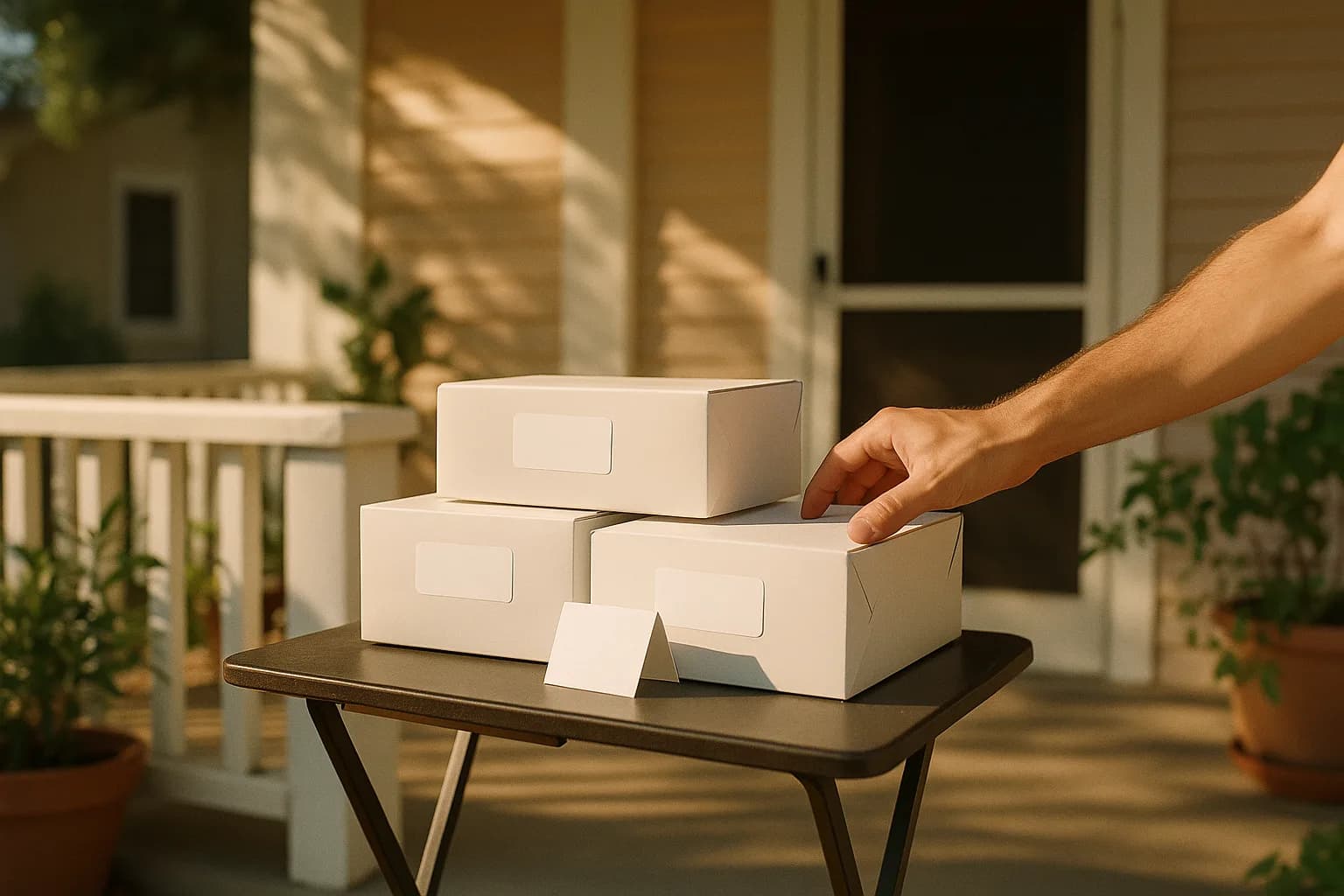
Print the label with all seven statutory elements, the 10-point sentence and your street address among them. Post a menu with a pickup day. Take the order and the payment first, then send the address. Hand the box over at your door, not from a stand in the yard. Log every sale in one place against the $250,000 line, and run the Department of Revenue wizard before your first candy sale.
Batch52 covers the middle of that list. A free shop on a batch52.com subdomain takes preorders against pickup windows you set, and the payment-timing setting can hold the order until the customer has paid by card, Venmo, Zelle, Cash App, PayPal, or cash at pickup. There is no commission on orders. Batch52 does not print labels, file your DR-1, or read your HOA covenants; those stay yours.
Sources
- Fla. Stat. 500.80 Cottage food operations, The 2026 Florida Statutes (Online Sunshine). https://www.leg.state.fl.us/statutes/index.cfm?App_mode=Display_Statute&URL=0500-0599/0500/Sections/0500.80.html
- Cottage Foods, Florida Department of Agriculture and Consumer Services (live web page). https://www.fdacs.gov/Business-Services/Food/Food-Establishments/Cottage-Foods
- Cottage Food Operations, FDACS Division of Food Safety, FDACS-P-02072 Rev. 07/21 (8-page guidance PDF, withdrawn from fdacs.gov; read via Wayback page 1 and City of Lake Wales mirror). https://www.lakewalesfl.gov/DocumentCenter/View/5488/Cottage-Food-Operations-and-Regulations
- Cottage Food in Florida, FSHN20-55 / FS425, UF/IFAS Extension EDIS (Ellis, Hagen, Krug), released 2021-09-13. https://ask.ifas.ufl.edu/publication/FS425
- Revenue Estimating Conference, Other Taxes and Fees, Issue: Cottage Food Operations, CS/HB 663 (analysis dated 2021-06-14), Florida Office of Economic and Demographic Research. https://edr.state.fl.us/Content/conferences/revenueimpact/archives/2021/_pdf/page469-471.pdf
- Fla. Stat. 500.03 Definitions (cottage food operation, cottage food product), The 2026 Florida Statutes. https://www.leg.state.fl.us/statutes/index.cfm?App_mode=Display_Statute&URL=0500-0599/0500/Sections/0500.03.html
- What Farmers Need to Know About Florida's Cottage Food Law?, UF/IFAS Extension Polk County, 2026-06-04. https://blogs.ifas.ufl.edu/polkco/2026/06/04/what-farmers-need-to-know-about-floridas-cottage-food-law/
- Fla. Stat. 500.80 and 500.03, 2025 and 2024 Florida Statutes, Florida Senate statutes site. https://www.flsenate.gov/Laws/Statutes/2025/0500.80
- CS/CS/CS/SB 700 (2025) Department of Agriculture and Consumer Services, ch. 2025-22: Senate bill page, enrolled text, House page; plus flsenate 'bills citing 500.80' searches for 2022 through 2026. https://www.flsenate.gov/Session/Bill/2025/700
- Cottage Food Operations 'Home Sweet Home Act' 2021 Update, UF/IFAS Extension Lee County, 2022-08-25. https://blogs.ifas.ufl.edu/leeco/2022/08/25/cottage-food-operations-home-sweet-home-act-2021-update/
- Selling Homemade Food in Florida, Institute for Justice. https://ij.org/issues/economic-liberty/homemade-food-seller/florida/
- r/cottagebakery: 'Florida Cottage Home Bakers' (2026-08-24) and 'Cottage Home Bakery Pickup Orders' (2026-08-29), same poster. https://www.reddit.com/r/cottagebakery/comments/1vx9w7v/florida_cottage_home_bakers/
- Food Allergies (major food allergens under FALCPA and the FASTER Act), U.S. Food and Drug Administration. https://www.fda.gov/food/nutrition-food-labeling-and-critical-foods/food-allergies
- r/florida: 'Foods allowed under cottage food laws' (March 2024, 39 comments). https://www.reddit.com/r/florida/comments/1bh0hnx/foods_allowed_under_cottage_food_laws/
- New Report Grades Each State's Laws for Homemade Food Sales (Baking Bad), Institute for Justice press release, 2022-03-24. https://ij.org/press-release/new-report-grades-each-states-laws-for-homemade-food-sales/
- Rule 12A-1.011, Florida Administrative Code, Sales of Food Products for Human Consumption by Grocery Stores, Convenience Stores, and Supermarkets (flrules.org record; text read at law.cornell.edu mirror). https://www.flrules.org/gateway/ruleno.asp?id=12A-1.011
- Form DR-46NT, Nontaxable Medical Items and General Grocery List, R. 11/25, Florida Department of Revenue. https://floridarevenue.com/Forms_library/current/dr46nt.pdf
- Florida Sales and Use Tax, and Account Registration pages, Florida Department of Revenue (with GT-800035 R. 11/22, Sales and Use Tax on Restaurants and Catering). https://floridarevenue.com/taxes/taxesfees/Pages/sales_tax.aspx
- Fla. Stat. 559.955 Home-based businesses; local government restrictions, The 2026 Florida Statutes. https://www.leg.state.fl.us/statutes/index.cfm?App_mode=Display_Statute&URL=0500-0599/0559/Sections/0559.955.html
- Santa Rosa County home bakery owner faces restrictions under 'cottage food laws', WEAR-TV, updated 2026-08-05. https://weartv.com/news/local/santa-rosa-county-home-bakery-owner-warned-to-stop-outdoor-sales-under-cottage-food-laws
- City of Fort Walton Beach weighs allowing cottage food carts, stands amid code complaints, Get The Coast, 2026-08-03. https://getthecoast.com/city-of-fort-walton-beach-weighs-allowing-cottage-food-carts-stands-amid-code-complaints/
- Cottage Food Insurance in Florida: What You Need & What It Costs (2026), floridacottagefoods.com, 2026-06-16. https://floridacottagefoods.com/blog/cottage-food-insurance-florida
- Cottage Food Insurance, FLIP (Food Liability Insurance Program). https://www.fliprogram.com/cottage-food-law-insurance
- Bakers Insurance, Insurance Canopy. https://www.insurancecanopy.com/food-liability-insurance/bakers
- How to Sell at Farmers Markets in Florida (2026), VendorLoop. https://getvendorloop.com/guides/how-to-sell-at-farmers-markets-in-florida
- Florida Fictitious Name Registration, Florida Department of State, Division of Corporations (Sunbiz). https://dos.fl.gov/sunbiz/start-business/efile/fl-fictitious-name-registration/
- CS/HB 707 (2022) Home Kitchen Operations, Florida Senate bill page and House Staff Analysis h0707.RRS (2022-02-05). https://www.flsenate.gov/Session/Bill/2022/707
- HB 1233 (2017) Cottage Food Operations, Florida Senate bill page and House Staff Analysis h1233c.COM (2017-03-29). https://www.flsenate.gov/Session/Bill/2017/1233
- CS/HB 7209 (2011) Consumer Services Functions/DOACS, Florida Senate bill page and enrolled text (Section 21 created s. 500.80). https://www.flsenate.gov/Session/Bill/2011/7209
- CS/HB 663 (2021) Cottage Food Operations ('Home Sweet Home Act'), Florida Senate bill page and House Final Bill Analysis h0663z1.RRS (2021-07-06). https://www.flsenate.gov/Session/Bill/2021/663
- Florida home bakers grow businesses under cottage food law, Spectrum Bay News 9, 2026-08-23. https://baynews9.com/fl/tampa/news/2026/08/23/florida-home-bakers-grow-businesses-under-cottage-food-law
Frequently asked questions
Do I need a license to sell baked goods from home in Florida?
No. Fla. Stat. 500.80(1)(a) exempts a cottage food operation from FDACS permitting as long as it complies with the section and its annual gross sales of cottage food products do not exceed $250,000. There is no registration, no license, and no routine inspection; FDACS may enter and inspect only upon receipt of a complaint. The live FDACS page, read September 6, 2026, says operators can sell directly to consumers without obtaining a food permit.
Can a Florida cottage food operation be an LLC?
Yes. Fla. Stat. 500.03(1)(i) defines a cottage food operation as a natural person or an entity that produces or packages cottage food products at the residence of the natural person, or at the residence of a natural person who has an ownership interest in the entity. An LLC qualifies as long as an owner's home is the kitchen. Registering a fictitious name with the Division of Corporations costs $50.00 and is valid for 5 years.
Can I sell cream cheese frosting or buttercream under Florida's cottage food law?
Cream cheese and real-butter icings are not allowed, according to FDACS's July 2021 guidance (archived copy), because they require refrigeration. Margarine, shortening, and vegan butter icings are permissible. The test is the statutory definition: a cottage food product is food that is not time or temperature controlled for safety. Cream, custard, and meringue pies fail the same test.
Is Florida's $250,000 cottage food cap on gross sales or profit?
Gross sales. Under Fla. Stat. 500.80(1)(b), annual gross sales include all sales of cottage food products at any location, regardless of the types of products sold or the number of persons involved in the operation, and the operation must give FDACS written documentation to verify those sales on request. The statute does not say calendar year or rolling twelve months. Above the ceiling you need an FDACS food permit like any other bakery.
Can I sell cottage food at a farmers market in Florida?
Yes. FDACS's July 2021 guidance approves sales at farmers markets, flea markets, and roadside stands provided no other food in your space requires a food permit, and both FDACS and UF/IFAS note that a market may still require vendors to hold a food license of its own. Fla. Stat. 500.80 has no insurance requirement, but secondary guides report that most Florida markets ask for $1,000,000 in general liability coverage naming the market as additional insured. Ask your market before you buy.
Can I sell cottage food from a stand in my front yard in Florida?
Likely not, under Fla. Stat. 559.955(3)(c), which bars a home-based business from conducting retail transactions at a structure other than the residential dwelling and requires the property to look residential from the street. In summer 2026, Santa Rosa County told a home bakery to remove its outdoor sales displays, and Fort Walton Beach code enforcement shut down a home cookie stand after a July 22, 2026 complaint. On that reading, a paid preorder handed over at your door is a transaction at the dwelling.

Nicholas Shiffert
Founder, Batch52
Nicholas builds Batch52, the ordering platform for home bakers and cottage food businesses. He spends most weeks talking with bakers about pickup days, pricing, and the paperwork nobody warned them about.
Research and drafting assisted by AI. Fact-checked, edited, and published by Nicholas Shiffert.