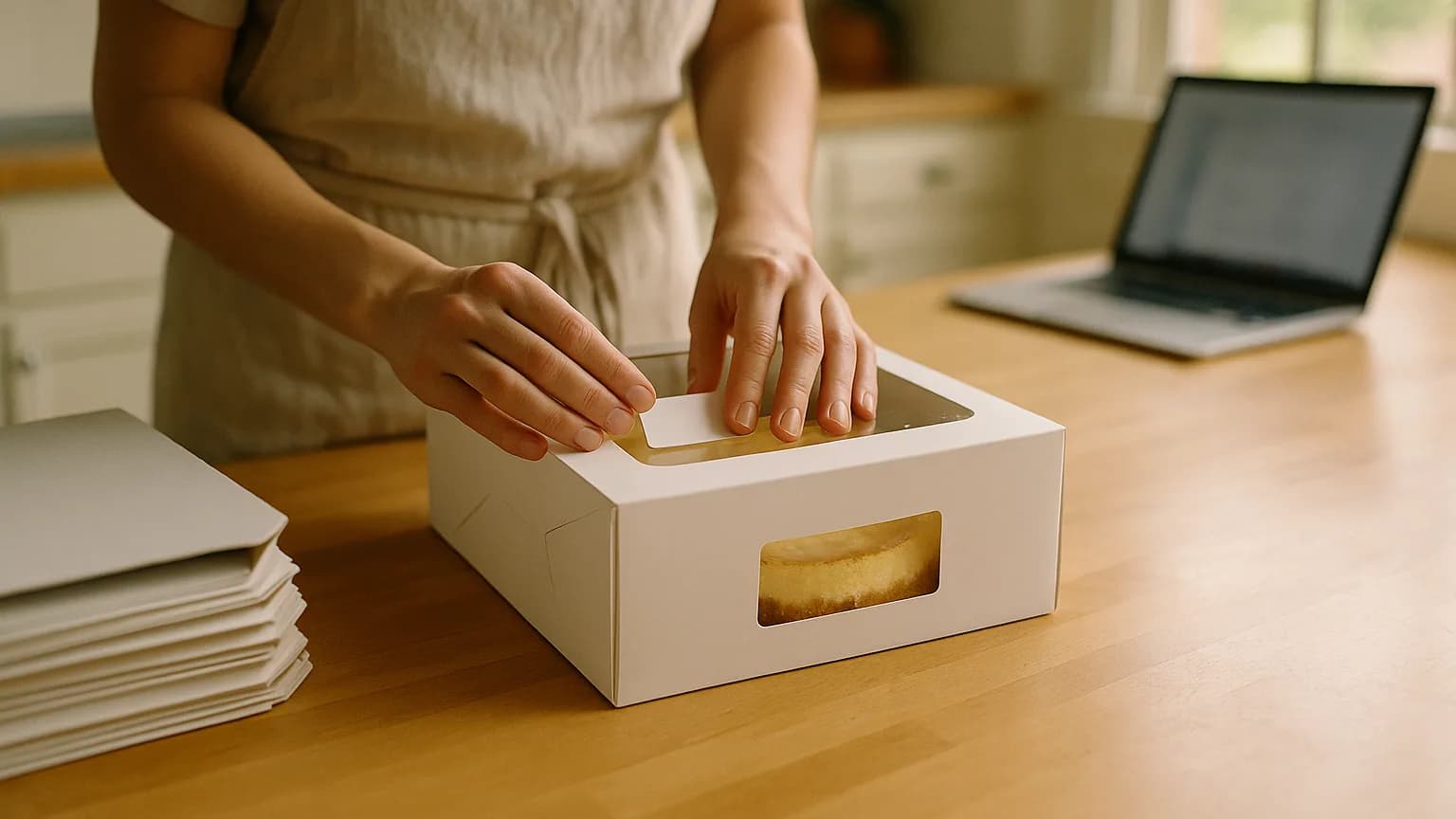
You bake cheesecakes in your kitchen in Katy, sell them by DM, and someone in a Facebook group told you cheesecakes are illegal for Texas cottage bakers. They were, until last September. What follows is the current law, read from the statute and the Texas Department of State Health Services (DSHS) page on September 6, 2026.
Since September 1, 2025, a Texas home baker can sell up to $150,000 a year of almost any food, refrigerated items included, with a free DSHS registration and a $15 food handler card. Every sale must be handed over in person by you, an employee, or someone in your household, and every label must carry the exact state disclosure. The short version lives on our Texas state page.
Key takeaways
- The cap is $150,000 in annual gross sales since September 1, 2025, up from $50,000. The statute indexes it to CPI-U, and DSHS had posted no adjusted figure as of September 6, 2026.
- Any food is allowed except six excluded categories. Refrigerated items such as cheesecake and cream pies are legal once you register with DSHS, which costs $0 and is approved online within minutes.
- Every sale is handed over in person by you, an employee, or a household member. Online orders are allowed. Couriers such as DoorDash are not, and every guide I read treats shipping by mail as off the table.
- Every label carries one all-caps disclosure plus your address or DSHS number. The only font-size rule in the statute is 12-point for the refrigerated-food safe-handling statement.
- The paperwork costs $15 for the food handler card, $0 for DSHS registration, and $15 for a county DBA certificate in Fort Bend County. Liability insurance is optional and starts at $299 a year with FLIP.
What changed on September 1, 2025
Senate Bill 541, enacted as Acts 2025, 89th Leg., R.S., Ch. 303, took effect on September 1, 2025, and is the most recent change to the Texas cottage food law as of September 6, 2026. Sen. Lois Kolkhorst wrote it and Rep. Lacey Hull carried it in the House.
The annual gross income cap went from $50,000 to $150,000. Refrigerated foods such as cream pies and cheesecakes became legal for operations that register with DSHS. The label sentence was replaced with a new all-caps disclosure, and a registered operation can print a DSHS number instead of its home address. Shelf-stable cottage foods can be sold at wholesale to a registered cottage food vendor. And a city that demands a permit from a cottage baker now has to fire the employee who knowingly did it.
The $150,000 cap, explained
Under Texas Health and Safety Code 437.001(2-b)(B), as amended effective September 1, 2025, a cottage food production operation must have an annual gross income of $150,000 or less from the sale of cottage foods, and the measure is gross sales, not profit. Before September 1, 2025, the cap was $50,000.
Texas tripled its cottage food cap in one bill after a $100,000 attempt died
View data
| law | Annual gross income cap (USD) |
|---|---|
| Before 2025-09-01 (25 TAC 229.661, 2022 text) | $50,000 |
| SB 829 (2023, proposed, died) | $100,000 |
| SB 541 (effective 2025-09-01) | $150,000 |
The statute directs DSHS to adjust the $150,000 annually for inflation using the Consumer Price Index for All Urban Consumers (CPI-U), but it sets no first-adjustment date, no rounding rule, and no duty to publish the adjusted figure. As of September 6, 2026, the DSHS cottage food page states the threshold as $150,000 and posts no adjusted figure or adjustment date. Plan against $150,000.
The cap attaches to the cottage food production operation, which the statute defines as an individual operating out of the individual's home or a nonprofit organization, and nothing in the chapter aggregates income across a household. So the cap is per operation, and an operation is one individual or one nonprofit. The statute does not say two people at one address each get their own cap. Do not build a plan on that reading.
Pasadena baker Azanett Bazan of Nan's Mexican Wedding Cookies told the Houston Chronicle in July 2025 that she brought in $42,000 to $45,000 a year and had been nervous about the old $50,000 cap. A cookie business that size now has room to triple.
What can you sell under the Texas cottage food law?
Any food that is not in one of six excluded categories. Since September 1, 2025, Texas cottage food operations may produce any food except six excluded categories: meat and poultry products; seafood, fish, and shellfish; ice products including shaved ice, ice cream, frozen custard, popsicles, and gelato; low-acid canned goods; products containing CBD or THC; and raw milk and raw milk products. That is the whole list.
Refrigerated foods, which the law calls time and temperature control for safety (TCS) foods, including cream or custard pies and cakes that require refrigeration, may be sold since September 1, 2025, provided the operation registers with DSHS. A TCS seller must store and deliver the food at temperatures that prevent bacterial growth, which DSHS specifies as 41°F or below for cold items and 135°F or above for hot items. A cooler with ice packs at a porch handoff meets that. A cake left on a porch in August does not.
The City of Mansfield's 2026 rules sheet and Homemade Texas list cheesecakes, custard pies, cream-filled pastries, flan, cut vegetables, and vegetarian casseroles among the foods that became legal on September 1, 2025.
Where and how you can sell
A Texas cottage food operation must sell directly to consumers or to a cottage food vendor and deliver the product at the point of sale or another location the buyer designates. Internet orders are allowed only if the operator, an employee, or a household member personally delivers the food; all label information except the address must be posted on the website before payment, and the address or DSHS unique ID must appear on the label after payment.
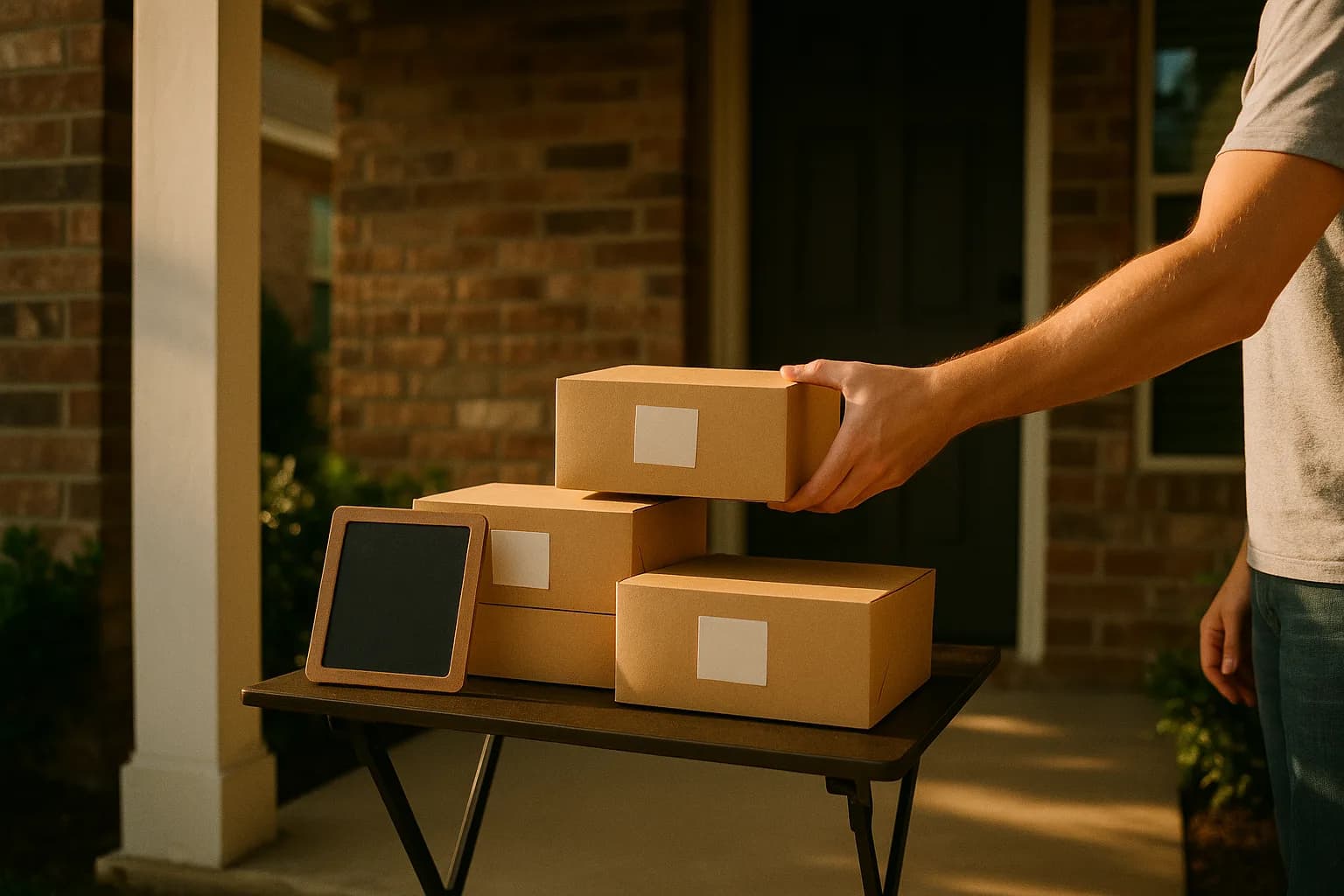
That personal-delivery rule shapes a pre-order business. The Texas Cottage Food Law FAQ states that a third-party courier such as DoorDash or UberEats cannot deliver a cottage food order, because an internet sale must be delivered by the operator, a household member, or an employee. Shipping is treated the same way: the Institute for Justice lists mail delivery as not permitted, and Texas A&M AgriLife's 2023 guide says products cannot be shipped or mailed. The Texas Cottage Food Law FAQ adds that the statute does not expressly prohibit shipping within Texas, but that legislators view the law as a local transaction. Kelley Masters of Homemade Texas told the Houston Chronicle in July 2025 that the one major priority SB 541 left unmet is that people still cannot ship their products.
The legal shape of a Texas home bakery is orders all week, handoff on a set day. That is the shape Batch52 is built around: pickup windows with lead times on every plan, and scheduled Batch Days on Pro.
Since September 1, 2025, a cottage food operation may sell at wholesale to a registered cottage food vendor any food other than the six excluded categories or a TCS food, so shelf-stable baked goods may be wholesaled and refrigerated ones may not. A cottage food vendor may sell cottage foods at a farmers' market, farm stand, food service establishment, or any retail store; it must post a sign with the all-caps disclosure, must register with DSHS if it buys at wholesale, and vendor-sold food must carry the date it was made on the label. The coffee shop down the street can stock your scones if it registers as a vendor, but not your cheesecake. Since September 1, 2025, an operation may also offer samples anywhere in Texas under the farmers' market sampling standards and may donate non-TCS foods to events such as bake sales.
Do you need a food handler card in Texas?
Yes, and it is the one document every operator must hold. The individual who operates a Texas cottage food operation must complete a DSHS-accredited food handler training program; household members and helpers under direct supervision need no card, and DSHS accepts a Food Manager Certification in place of a food handler certificate where applicable. Texas A&M AgriLife Extension's DSHS-accredited Food Handlers Course costs $15.00 per person, takes less than 2 hours, and issues a certificate valid for 2 years, as displayed on September 6, 2026. For a cookie-and-cake baker who does not mind a home address on the label, this is the only step the cottage food law requires.
Your label, word for word
Since September 1, 2025, every Texas cottage food label must carry the exact disclosure below, along with the name and address (or DSHS unique ID) of the operation.
Copy it in capitals with the period. The statute sets no font size for it. Before September 1, 2025, the required statement was "This food is made in a home kitchen and is not inspected by the Texas Department of State Health Services or a local health department." If a label template you downloaded still has that sentence, it is out of date.
The DSHS checklist adds legible writing, the common or usual name of the product, any major allergen used (DSHS lists eggs, tree nuts, soy, peanuts, milk, wheat, and sesame), and a unique batch number for pickled, fermented, or acidified goods; items too bulky to package carry the label information on an invoice or receipt.
| Label element | Who needs it |
|---|---|
| Legible writing | Everyone |
| Name of the operation | Everyone |
| Home address, or DSHS unique ID if registered | Everyone |
| Common or usual name of the product | Everyone |
| Major allergens used | Everyone |
| The all-caps disclosure | Everyone |
| Unique batch number | Pickled, fermented, or acidified goods |
| Date the food was made | TCS foods; any food sold through a vendor |
| Safe-handling statement, at least 12-point | TCS foods, on the label or receipt |
A TCS (refrigerated) cottage food must show the date it was made on the label and, on the label or a receipt, the statement "SAFE HANDLING INSTRUCTIONS: To prevent illness from bacteria, keep this food refrigerated or frozen until the food is prepared for consumption." in at least 12-point font, and this is the only font-size rule in the statute.
DSHS registration: free, online, approved in minutes
DSHS cottage food registration is optional for an operation that wants a unique identification number in place of its home address on labels, and mandatory for operations selling TCS foods and for cottage food vendors that buy at wholesale.
DSHS lists no fee for registration: none appears in the statute, on the DSHS page, or in the DSHS registration guide, and the City of Mansfield's 2026 rules sheet and texascottagefoodlaw.com both state that registration is free. Registration runs through the Online Licensing Services portal at vo.ras.dshs.state.tx.us, requires a separate DSHS online account and a home address (no P.O. box), is approved automatically within minutes, and issues a License Number that serves as the unique identifier for labels.
Have your paperwork ready before you open the portal. The onboarding screen in the DSHS guide shows Social Security number and date of birth fields, and the final attestation has sole proprietors certify they have filed an assumed name certificate in the appropriate counties. That certificate is covered in the next section.
Do Texas cottage bakers charge sales tax?
Not on a cold box of cookies. Under Texas Comptroller rule 34 TAC 3.293, food and food ingredients are exempt from sales tax unless otherwise taxable, and bakery items (bread, rolls, cakes, pies, cookies, tortillas, and similar) become taxable only when sold heated, with plates or eating utensils, or with a taxable meal. The Comptroller counts plates, forks, cups, and similar items as eating utensils, but not napkins, and treats cupcakes, kolaches, and scones as bakery items. A cold dozen cookies in a box with a napkin is exempt. The same cookies on a plate with forks at a market table are taxable.
Candy is subject to Texas sales tax, including bars, drops, taffy, and other confections made with sweeteners, and nuts or fruit that have been candied or coated with chocolate, yogurt, or caramel. Snack items such as granola bars, chips, popcorn, nuts, and trail mix are taxable when sold in an individual-sized portion, meaning less than 2.5 ounces or labeled as not more than one serving, and not taxable in multi-packs or larger sizes. Neither Comptroller document I read says whether a seller of exempt-only items needs a sales and use tax permit. Ask the Comptroller before your first taxable sale.
A Texas sole proprietor using a business name files an assumed name (DBA) certificate with the county clerk of each county where they do business; Fort Bend County charges $15.00 for one owner ($14.00 if pre-notarized), valid up to 10 years, while LLCs and corporations file with the Secretary of State for $25. Whether a cottage food operation can be an LLC is unsettled: the Farm and Ranch Freedom Alliance reads the statute's "an individual" as excluding entities such as an LLC, while the DSHS registration form offers LLC as an entity type. Ask a Texas attorney before you form one.
Insurance and markets
Texas law does not require a cottage food operation to carry liability insurance; the Texas Cottage Food Law FAQ recommends it and notes that some markets and venues require proof of coverage. Food Liability Insurance Program (FLIP) cottage food liability insurance starts at $25.92 per month or $299 per year as displayed on September 6, 2026, with a $1,000,000 per-occurrence limit, $2,000,000 general liability and product liability aggregates, and no deductible, and FLIP's pricing page states no revenue tier breakpoints.
Markets are where the insurance question stops being optional. Texas Farmers Market in Austin (Mueller and Lakeline), under rules last revised May 21, 2024, requires every vendor to hold a $1,000,000 general liability policy and provide a certificate of insurance for each market naming the market's full name and physical address. Its booth fees, as posted on September 6, 2026, run $50 to $70 per week for agricultural, value-added, prepared food, and artisan vendors. Other Texas markets set their own fees and rules, and none of them are state law.
Cities, HOAs, and the limits of preemption
Under Texas Health and Safety Code 437.0192(a), effective September 1, 2025, a local government authority, including a local health department, may not regulate the production of food at a cottage food operation or require any license, permit, or fee to produce, sell directly to a consumer or vendor, or provide samples. Under 437.0192(c), a local government may not employ or continue to employ a person who knowingly requires or attempts to require a cottage food operation to obtain a license or permit.
The preemption text says nothing about zoning, signage, or traffic, and both the Institute for Justice and the Texas Cottage Food Law FAQ say local venue rules, HOA covenants, and commercial-activity ordinances can still apply to where and how cottage food is sold. Austin's Land Development Code section 25-2-900 on home occupations, as reproduced on a third-party code mirror I read on September 6, 2026, prohibits selling merchandise directly to a customer on the premises, limits customer-related traffic to three vehicle trips per day, and bars advertising the home's street address; whether it can be enforced against cottage food porch pickup is unresolved. Your HOA's covenants sit outside the statute entirely. Read them before you post a pickup address.
Cities have tested the line before. In May 2012, before the 2013 preemption law, the City of Frisco sent home baker Jaime Medley a notice that her cottage food operation violated its zoning ordinance, saying the ordinance predated the 2011 cottage food law. According to Homemade Texas, the City of Waxahachie required cottage food producers to buy a Food Establishment permit and submit recipes in 2022, and as of a post dated July 27, 2026 requires a sworn, notarized affidavit before operating in city limits; the groups asked for a simple registration form instead, and the outcome was unknown as of September 6, 2026. That is Homemade Texas's account, and I have not seen the city's.
Enforcement in practice
Neither DSHS nor local health departments inspect or permit Texas cottage food operations; they must keep records of complaints, and may act only against an immediate and serious threat to human life or health through emergency or recall orders. Nobody is coming to look at your kitchen. What exists is a complaint file if a customer calls, and a recall power if someone gets sick.
How Texas got here
Texas's first cottage food law, SB 81, took effect September 1, 2011 and allowed baked goods, jams, jellies, and dried herbs sold from the home. HB 970 took effect September 1, 2013 and added foods, market and event venues, and the food handler card, and amended the local preemption section. SB 572 took effect September 1, 2019 and allowed any non-TCS food except meat, sales anywhere in Texas, and internet orders with in-person delivery. No law passed in 2023: SB 829, which proposed a $100,000 cap, the address alternative, and vendors, passed the Senate and died on the House calendar after May 23, 2023. Most of it came back two years later with a bigger number.
| Bill | Effective | What it did |
|---|---|---|
| SB 81 | September 1, 2011 | Baked goods, jams, jellies, dried herbs; sales from the home only |
| HB 970 | September 1, 2013 | More foods; markets, farm stands, events; food handler card; amended local preemption |
| SB 572 | September 1, 2019 | Any non-TCS food except meat; sales anywhere in Texas; online orders with in-person delivery |
| SB 829 | Never (died May 23, 2023) | Proposed $100,000 cap, address alternative, vendors |
| SB 541 | September 1, 2025 | $150,000 indexed cap; six exclusions only, TCS with registration; address alternative; vendors and wholesale; hardened preemption |
What the statute and the DSHS page said on September 6, 2026
I read Health and Safety Code chapter 437 and the DSHS cottage food page on September 6, 2026, a year and five days after SB 541 took effect.
The rule is behind the statute. As of September 6, 2026, the DSHS cottage food rule at 25 TAC 229.661 was last amended effective October 9, 2022 and still states the $50,000 cap and the pre-2025 label statement, and the DSHS page still says DSHS will adopt rules to implement the new requirements. A page that cites the Texas Administrative Code for cottage food is quoting the old law. The statute controls.
The cap has not moved yet. The statute tells DSHS to index $150,000 to CPI-U each year, and as of September 6, 2026, DSHS has published no adjusted figure or date. Any site printing a computed 2026 number is doing its own math.
The statute has a typo. The codified text of Texas Health and Safety Code 437.0194(a-1) and (b) cites the excluded-foods list as Sections 437.002(2-b)(A)(i)-(vi), but that list sits in 437.001(2-b)(A), and the cross-reference appears to be a drafting error carried from SB 541. It changes nothing about what you can sell.
One widely cited page is partly stale. The Institute for Justice's Texas page, last updated December 2025, grades Texas A-, lists the cap as $150,000, but still prints the pre-2025 label statement, says no license, permit, or registration is required, and says dairy is barred, none of which matches the current statute.
So the test for any Texas cottage food page, including this one a year from now, is three questions. Does it say $150,000? Does it print the all-caps disclosure? Does it date its reading of the statute? If a page says $50,000 or prints the "home kitchen" sentence, it is describing the law before September 1, 2025. Check the date before you print a label from it.
Sources
- Texas Health and Safety Code ch. 437, current text (cottage food sections 437.001, 437.0191-437.01965, 437.0197, 437.020). https://statutes.capitol.texas.gov/Docs/HS/htm/HS.437.htm
- SB 541 bill history, 89(R) 2025, Texas Legislature Online. https://capitol.texas.gov/BillLookup/History.aspx?LegSess=89R&Bill=SB541
- Texas Cottage Food Production, Texas Department of State Health Services. https://www.dshs.texas.gov/retail-food-establishments/permits-retail-food-establishments/texas-cottage-food-production
- Evolution of the Texas Cottage Food Law, texascottagefoodlaw.com. https://texascottagefoodlaw.com/evolution/
- 25 Tex. Admin. Code 229.661 Cottage Food Production Operations (Cornell LII copy). https://www.law.cornell.edu/regulations/texas/25-Tex-Admin-Code-SS-229-661
- Cottage Food Law: Open Letter to TX Cities & Counties (2025-08-11), Farm and Ranch Freedom Alliance with Homemade Texas. https://farmandranchfreedom.org/cottage-food-law-sb541/
- Texas cottage food businesses prepare for major expansion (July 2025), Houston Chronicle. https://www.houstonchronicle.com/food-culture/restaurants-bars/article/texas-cottage-food-new-law-20780682.php
- SB 541 enrolled text, 89(R) 2025, Texas Legislature Online. https://capitol.texas.gov/tlodocs/89R/billtext/html/SB00541F.htm
- Basics - Texas Cottage Food Law (current as of 2025-09-01). https://texascottagefoodlaw.com/basics/
- Texas Cottage Food Rules (2026 Edition), City of Mansfield Regulatory Compliance (PDF, last updated 01/28/2026). https://www.mansfieldtexas.gov/DocumentCenter/View/18257
- SB 541 PASSES - Effective September 1, 2025, Homemade Texas. https://homemadetexas.org/sb-541-passes-effective-september-1-2025/
- FAQ - Texas Cottage Food Law. https://texascottagefoodlaw.com/faq/
- Selling Foods Made at Home: Texas Cottage Food Law, NUTR-PU-149 (October 2023), Texas A&M AgriLife Extension. https://agrilifeextension.tamu.edu/wp-content/uploads/2025/08/Selling-Food-at-Home-Texas-Cottage-Food-Law.pdf
- Selling Homemade Food in Texas (updated December 2025), Institute for Justice. https://ij.org/issues/economic-liberty/homemade-food-seller/texas/
- Accredited Food Handler Internet (Online) Training Programs, Texas DSHS (plus parent page). https://www.dshs.texas.gov/licensing-food-handler-training-programs/accredited-food-handler-internet-online-training-programs
- Food Handlers Course for Cottage Food Businesses, Texas A&M AgriLife Extension. https://foodsafety.tamu.edu/courses/food-handlers-course-for-cottage-food-businesses
- Cottage Food Registration Guide Ver2 (2025), Texas DSHS (PDF, 7 pages). https://www.dshs.texas.gov/sites/default/files/foodestablishments/cottagefood/Cottage%20Food%20Registration%20Guide%20Ver2%20_%202025%20.pdf
- DSHS Registration, texascottagefoodlaw.com. https://texascottagefoodlaw.com/dshs-registration/
- 34 Tex. Admin. Code 3.293 Food; Food Products; Meals; Food Service (Cornell LII copy). https://www.law.cornell.edu/regulations/texas/34-Tex-Admin-Code-SS-3-293
- Grocery and Convenience Stores: Taxable and Nontaxable Sales, Texas Comptroller Publication 96-280 (03/2024). https://comptroller.texas.gov/taxes/publications/96-280.php
- DBA/Assumed Name, Fort Bend County Clerk (Texas). https://www.fortbendcountytx.gov/government/departments/county-clerk/dba-assumed-name
- Name Filings FAQs (assumed name certificates), Texas Secretary of State. https://www.sos.state.tx.us/corp/namefilingsfaqs.shtml
- Cottage Food Insurance, Food Liability Insurance Program (FLIP). https://www.fliprogram.com/cottage-food-law-insurance
- Food Business Insurance Cost - Price & Coverage Details, FLIP. https://www.fliprogram.com/food-business-insurance-cost
- Market Rules, Texas Farmers Market (Austin: Mueller and Lakeline; rev. 2024-05-21). https://texasfarmersmarket.org/market-rules
- Austin Land Development Code 25-2-900 Home Occupations (elaws mirror). http://austin-tx.elaws.us/code/ldc_title25_ch25-2_subchc_art5_sec25-2-900
- Home Baker Criticizes Frisco Zoning Ordinance, NBC 5 Dallas-Fort Worth (2012-05-08). https://www.nbcdfw.com/news/local/city-zoning-preventing-home-bakeries/1949406/
- Homemade Texas and FARFA send joint letter to the City of Waxahachie (again), 2025-07-23. https://homemadetexas.org/homemade-texas-and-farfa-send-joint-letter-to-the-city-of-waxahachie-again/
- Waxahachie does it again, Homemade Texas (2026-07-27). https://homemadetexas.org/waxahachie-does-it-again/
- Cottage Foods guidance, NET Health (Northeast Texas Public Health District, Tyler / Smith County). https://www.mynethealth.org/departments/environmental-health/retail-food-protection-program/cottage-foods
- SB 81 bill history, 82(R) 2011, Texas Legislature Online. https://capitol.texas.gov/BillLookup/History.aspx?LegSess=82R&Bill=SB81
- HB 970 bill history, 83(R) 2013, Texas Legislature Online. https://capitol.texas.gov/BillLookup/History.aspx?LegSess=83R&Bill=HB970
- SB 572 bill history, 86(R) 2019, Texas Legislature Online. https://capitol.texas.gov/BillLookup/History.aspx?LegSess=86R&Bill=SB572
- SB 829 bill history, 88(R) 2023, Texas Legislature Online. https://capitol.texas.gov/BillLookup/History.aspx?LegSess=88R&Bill=SB829
- C.S.S.B. 829 Senate committee bill analysis, 88(R) 2023. https://capitol.texas.gov/tlodocs/88R/analysis/html/SB00829S.htm
Frequently asked questions
Can I ship cottage food or use DoorDash to deliver it in Texas?
Not by courier, and no source I read permits shipping. A Texas internet order must be delivered in person by the operator, an employee, or a household member. The Texas Cottage Food Law FAQ says a courier such as DoorDash or UberEats cannot deliver a cottage food order, and adds that the statute does not expressly prohibit in-state shipping but legislators view the law as a local transaction. The Institute for Justice lists mail delivery as not permitted, and Texas A&M AgriLife's 2023 guide says products cannot be shipped or mailed.
Do I need a license or permit to sell baked goods from home in Texas?
No license or permit exists for a Texas cottage food operation, and neither DSHS nor local health departments inspect one. The operator must hold a DSHS-accredited food handler card, which costs $15.00 at Texas A&M AgriLife Extension. Free DSHS registration is required only to sell refrigerated foods or to print a DSHS number instead of a home address on labels. Since September 1, 2025, a city or county may not require any license, permit, or fee to produce or sell cottage food.
Can I sell cheesecake under the Texas cottage food law?
Yes, since September 1, 2025, if the operation registers with DSHS. Cheesecakes, cream pies, and custard pies are time and temperature control for safety (TCS) foods. They must be stored and delivered at 41°F or below, the label must show the date the food was made, and the label or receipt must carry the safe-handling statement in at least 12-point font. Refrigerated foods cannot be sold at wholesale to a cottage food vendor.
Is the Texas $150,000 cottage food cap per person or per household?
The cap attaches to the cottage food production operation, which the statute defines as an individual operating out of the individual's home or a nonprofit organization. Nothing in chapter 437 aggregates income across a household, but the statute also does not say two people at one address each get their own $150,000. The DSHS cottage food page does not address it. Do not build a plan on the two-cap reading.
Can a Texas cottage food operation be an LLC?
Unsettled as of September 6, 2026. The statute defines an operation as an individual or a nonprofit organization, and the Farm and Ranch Freedom Alliance reads that as excluding entities such as an LLC. The DSHS registration form nonetheless offers LLC as an entity type. Ask a Texas attorney before forming one. A sole proprietor using a business name files an assumed name certificate with the county clerk instead; Fort Bend County charges $15.00 for one owner.

Nicholas Shiffert
Founder, Batch52
Nicholas builds Batch52, the ordering platform for home bakers and cottage food businesses. He spends most weeks talking with bakers about pickup days, pricing, and the paperwork nobody warned them about.
Research and drafting assisted by AI. Fact-checked, edited, and published by Nicholas Shiffert.