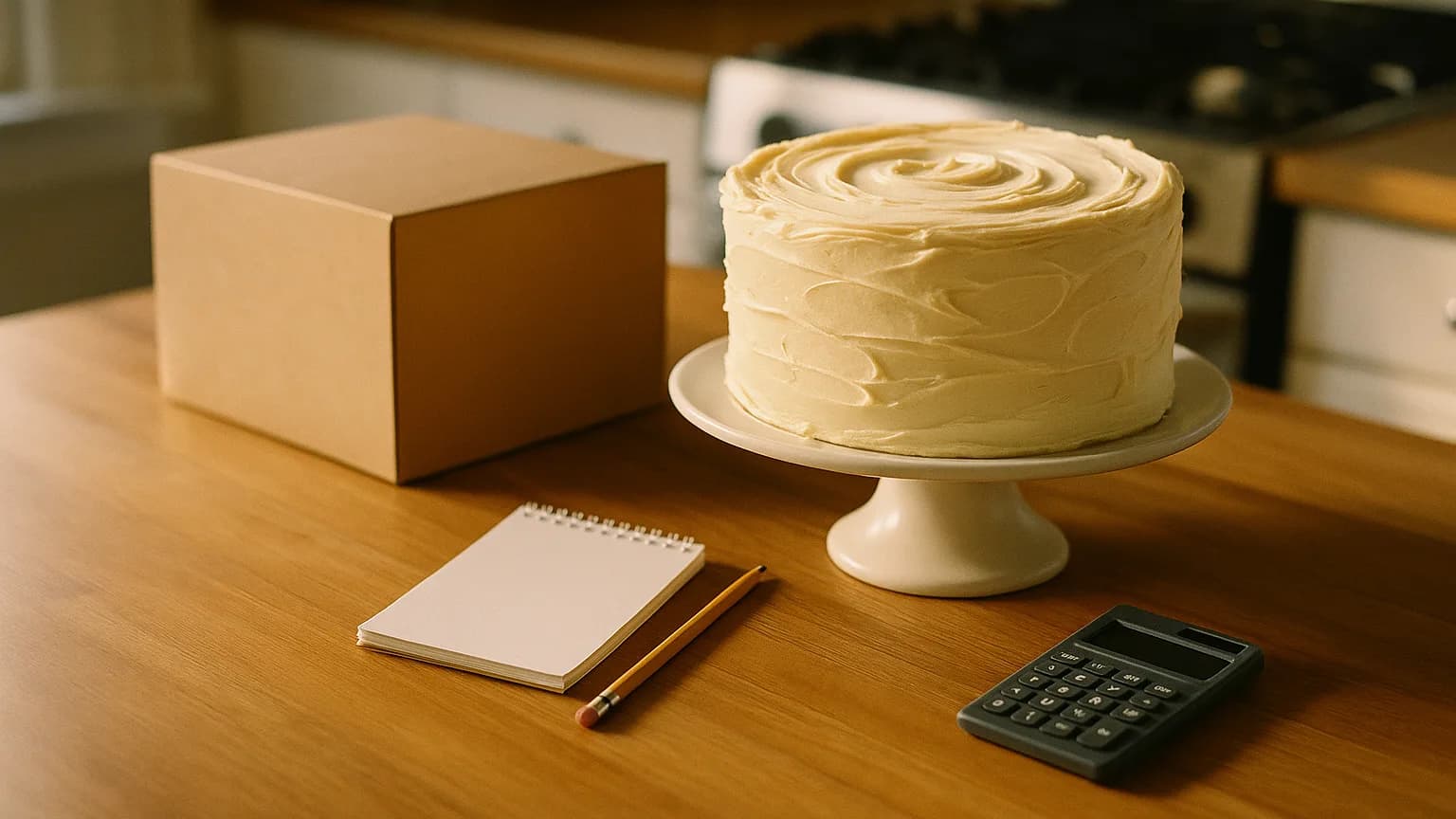
Most free cake calculators hand you a number with the detailed work hidden. They take some mix of ingredient cost, hours, hourly rate, overhead, and a margin or multiplier, then return a price. A couple show a cost summary, but none publishes the per-ingredient arithmetic. This article runs the same calculation in the open, on August 2026 grocery prices, so you can check every line against your own receipts.
The formula in one sentence: price = (materials + hours x hourly rate + overhead share) / (1 - margin). Run at $25 an hour and a 20% margin, it produces a 6-inch buttercream cake at $108.79, a stacked two-tier at $240.94, and a half sheet at $168.26. The rest of this article is the work, the assumptions, and the places the calculator is wrong. To run your own numbers through the same formula, use our free cake pricing calculator: no signup, and it shows every line of the math.
Key takeaways
- The cost-plus formula is price = (materials + hours x hourly rate + overhead share) / (1 - margin). At a 20% margin, divide total cost by 0.8; at 30%, divide by 0.7.
- Run at $25 an hour on August 2026 BLS grocery prices, it produces a 6-inch buttercream at $108.79, a two-tier at $240.94, and a half sheet at $168.26.
- Labor, not ingredients, is about two-thirds of each cake's total cost; butter at $4.021 a pound is the expensive ingredient line.
- The most common failure is undercounted labor: one guide estimates bakers miss 30-40% of their hours, and forum bakers report effective pay of $5-13 an hour.
- Small cakes price worst per serving. A real wage on a 6-inch lands above the $55-85 home-baker market range, so the formula's job is to show you the floor before you agree to the order.
The cake pricing formula
Cake-business educators converge on a four-part model: ingredients, labor at an hourly rate, a share of overhead, and a profit margin. Some guides extend it with a complexity multiplier for hard designs and a delivery fee billed separately.
Margin and markup are different math, and guides mix them loosely. Markup divides profit by cost; margin divides profit by price, so a 100% markup is a 50% margin. The published figures disagree: one guide suggests a 15-25% margin, another a 30-40% margin with a 20% beginner floor, a third a 60-100% markup on cost. This article uses a 20% true margin, the beginner floor, which makes the last step "divide total cost by 0.8."
The inputs, August 2026
The food cost anchors to U.S. city-average retail prices from the Bureau of Labor Statistics for August 2026: eggs $2.272 a dozen, flour $0.548 a pound, sugar $1.024 a pound, butter $4.021 a pound, milk $4.229 a gallon.
Butter is the expensive line in every cake; flour and sugar are nearly free
View data
| item | U.S. average retail price (USD) |
|---|---|
| Eggs (dozen) | $2.272 |
| Flour (lb) | $0.548 |
| Sugar (lb) | $1.024 |
| Butter (lb) | $4.021 |
| Milk (gallon) | $4.229 |
The small ingredients have no federal price series, so the worked cakes carry assumed prices, marked illustrative in each table: about $1.20 a pound for powdered sugar, $0.30 a teaspoon for vanilla, $0.50-0.75 for coloring per cake. One guide's itemized 8-inch vanilla cake puts total materials at $14.82 including board, box, and dowels, with fondant adding $3-6 and specialty fillings $2-4, which is the right order of magnitude for these assumptions. Published examples put a 6-inch cake's ingredients anywhere from about $6 to $24 depending on scope. Packaging runs about $2.80-3.00 for a standard cake and $10 or more on a tiered one.
For the hourly rate, the legal floor is the $7.25 federal minimum wage. Guides suggest paying yourself $15-25 an hour depending on skill, with one guide calling $25 the floor for a sustainable business and $35-50 appropriate for high-cost areas or experienced decorators; treat those numbers as guide opinion, not a market rate. The worked cakes use $25.
Overhead is real money before the oven turns on. Liability insurance for a home bakery starts at $299 a year. One guide itemizes a typical annual bundle, from insurance to utilities, at $1,650-3,700, which works out to $33-74 per cake at 50 cakes a year. The worked cakes assume $2,400 a year spread over 100 orders, a $24 base share per order, weighted up to $36 for the two-tier and down to $12 for the 6-inch. That model is an assumption; yours is last year's receipts divided by orders. Guides that prefer a shortcut suggest adding roughly 15-25% for overhead instead.
Worked example one: the 6-inch at $108.79
A 6-inch round, two layers, American buttercream, about 10 party servings. Labor assumption: 2.5 hours covering a 15-minute consult, 15 minutes of shopping, 60 minutes of baking and cooling oversight, 45 minutes of coating and finish work, and 15 minutes of boxing and cleanup.
| Line | Cost |
|---|---|
| Flour, 0.7 lb at $0.548/lb | $0.38 |
| Sugar, 0.8 lb at $1.024/lb | $0.82 |
| Butter, 1.25 lb at $4.021/lb | $5.03 |
| Eggs, 3 at $0.189 each | $0.57 |
| Milk, 0.5 cup | $0.13 |
| Powdered sugar, 0.75 lb (illustrative) | $0.90 |
| Vanilla, leavening, salt (illustrative) | $0.75 |
| Food coloring (illustrative) | $0.50 |
| Food subtotal | $9.08 |
| Waste allowance, 5% | $0.45 |
| Board, box, label | $3.00 |
| Materials total | $12.53 |
| Labor, 2.5 hr x $25 | $62.50 |
| Overhead share | $12.00 |
| Total cost | $87.03 |
| Price, $87.03 / 0.8 | $108.79 |
Quote it at $105-110. That is $10.88 a serving across 10 servings, and the cake pays $33.70 per effective hour once the margin is counted.
The uncomfortable part: $105-110 sits above one guide's $55-85 home-baker range for mid-cost areas, inside a 2025 vendor survey's $70-120 band, and well above a published bakery list's $45-55 for a 6-inch round. A real wage on a small cake lands near the top of the market. If your buyers will not pay it, the honest options are a faster process, a simpler finish, or a higher-income market. Do not quietly work for $9 an hour instead.
Worked example two: the two-tier at $240.94
A 6-plus-8-inch two-tier, buttercream, stacked and doweled, about 32 party servings. Labor assumption: 5 hours, since stacking and doweling add about 45 minutes over two separate cakes.
| Line | Cost |
|---|---|
| Flour, 1.6 lb | $0.88 |
| Sugar, 1.8 lb | $1.84 |
| Butter, 3.0 lb | $12.06 |
| Eggs, 7 | $1.32 |
| Milk, 1 cup | $0.26 |
| Powdered sugar, 1.75 lb (illustrative) | $2.10 |
| Vanilla, leavening, salt (illustrative) | $1.50 |
| Food coloring (illustrative) | $0.75 |
| Food subtotal | $20.71 |
| Waste allowance, 5% | $1.04 |
| Drum, tier board, box, dowels | $10.00 |
| Materials total | $31.75 |
| Labor, 5 hr x $25 | $125.00 |
| Overhead share | $36.00 |
| Total cost | $192.75 |
| Price, $192.75 / 0.8 | $240.94 |
Quote it at $240. That is $7.53 a serving and $34.64 per effective hour. The per-serving rate lands inside the $6-8.50 band one guide publishes for tiered fondant work. The quote sits at the top of one guide's $150-250 home-baker range, inside the vendor survey's $200-400, and above the roughly $120-152 implied by a bakery list quoting $3.75-4.75 per slice.
Worked example three: the half sheet at $168.26
A 12x18 half sheet, single layer, frosted with a border and message, about 50 servings. Labor assumption: 3.5 hours. Sheet cakes are fast per serving because there is no stacking.
| Line | Cost |
|---|---|
| Flour, 2.0 lb | $1.10 |
| Sugar, 2.0 lb | $2.05 |
| Butter, 2.0 lb | $8.04 |
| Eggs, 8 | $1.51 |
| Milk, 1.5 cups | $0.40 |
| Powdered sugar, 1.5 lb (illustrative) | $1.80 |
| Vanilla, leavening, salt (illustrative) | $1.45 |
| Cocoa or coloring (illustrative) | $0.90 |
| Food subtotal | $17.25 |
| Waste allowance, 5% | $0.86 |
| Half-sheet board and box | $5.00 |
| Materials total | $23.11 |
| Labor, 3.5 hr x $25 | $87.50 |
| Overhead share | $24.00 |
| Total cost | $134.61 |
| Price, $134.61 / 0.8 | $168.26 |
Quote it at $165-170. That is $3.37 a serving and $34.61 per effective hour. It lands inside the $140-220 range one guide reports for home-baker custom half sheets, and far above grocery half sheets at $21-59. Those are different product classes: a store sheet cake is mass-produced, often frozen, by staff on a wage. You are not competing with it.
Labor, not ingredients, is most of every cake's cost
View data
| cake | Materials (USD) | Labor (USD) | Overhead share (USD) |
|---|---|---|---|
| 6-inch round | $12.53 | $62.5 | $12 |
| Two-tier (6"+8") | $31.75 | $125 | $36 |
| Half sheet | $23.11 | $87.5 | $24 |
Same cakes, different dials
The hourly rate moves the price more than any other input. Hold everything else fixed: the 6-inch falls to $93.16 at $20 an hour and climbs to $124.33 at $25 an hour with a 30% margin. The two-tier reaches $303.44 at $35 an hour. If $25 feels high, run your number, not a forum's number.
Does the answer hold up?
Yes, with one tension to manage. Per-serving quoting is the custom-cake convention, with guides publishing bands near $3.50-4.50 for simple buttercream, $4.50-6.00 for piped detail, and $6.00-8.50 for fondant two-tier work; a real bakery list quotes $3.75 a slice for buttercream and $4.75 for fondant. Serving counts depend on the cut: roughly 8-12 party servings for a 6-inch and 20-24 for an 8-inch, with wedding-size slices yielding about 25-30% more.
| Cake | Home-baker range (mid-cost areas) | 2025 vendor survey | Published retail list |
|---|---|---|---|
| 6-inch round | $55-85 | $70-120 | $45-55 (buttercream-fondant) |
| 8-inch round | $75-120 | $120-180 | $75-95 |
| 10-inch round | $110-165 | $150-250 | $105-130 |
| Two-tier (6"+8") | $150-250 | $200-400 | ~$120-152 implied (32 servings x $3.75-4.75 a slice) |
| Half sheet | $140-220 | $40-70 (generic market) | n/a |
| Wedding cake | n/a | $700-1,100 typical; $917 national average | n/a |
| Grocery half sheet | n/a | n/a | $21-59 (Costco $27.99, serves 48) |
Whole-cake ranges vary by source and market tier: one guide's mid-cost-area ranges put a 6-inch at $55-85 and a two-tier at $150-250, while a 2025 vendor survey reports $70-120 and $200-400 and a $917 national wedding-cake average attributed to Zola. Grocery benchmarks are a separate product class entirely: a Costco half sheet serving 48 was $27.99 in 2026, about $0.58 a slice. A retired baker in a forum thread describes a store 8-inch as roughly $3 of food cost, wholesaled near $12, produced about 50 at a time and frozen; treat that as one person's account, but the economics point the same direction.
The tension is the 6-inch. Small cakes price worst per serving because the labor barely shrinks with the cake. If $105 is unsellable where you live, the formula still did its job: it told you the floor before you agreed to the order.
Where the cake pricing calculator is wrong, and how to adjust
It believes your hours. Across educator guides and baker forums, unpaid or undercounted labor is the most commonly named pricing mistake, and one guide estimates bakers undercount by 30-40% once you count consults, shopping, cleanup, and delivery coordination; that guide's task list for a moderately decorated cake totals 3 hours 45 minutes. Bakers in forum threads report 6-hour cakes priced mostly on ingredients, working out to about $5-13 an hour, and a 2010 thread has a baker confessing to charging $35-45 for cakes that took 6 hours each. Fix: time your next three cakes and use your own minutes.
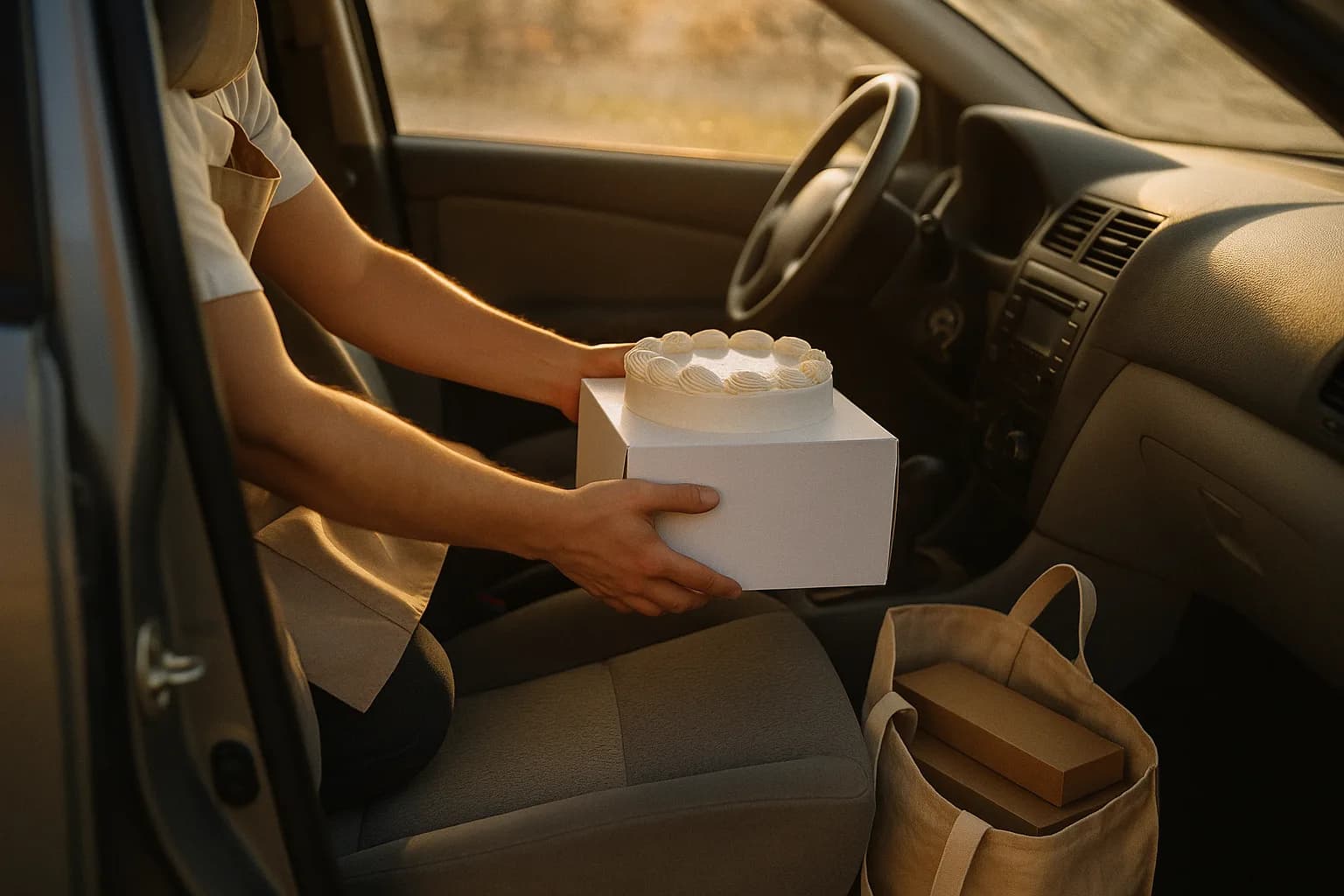
It skips delivery. One guide calls free delivery the single biggest pricing mistake and estimates a 30-minute round trip at $25-40; a published bakery list charges delivery at government mileage rates. Worked example: 20 round-trip miles at the IRS rate of 76 cents for July through December 2026 is $15.20, plus half an hour at $25 is $12.50, about a $28 delivery fee.
The 3x shortcut is a different tool. Multiplying ingredients by three is defensible as a markup on materials with labor billed separately; as a whole price it fails, and one guide's arithmetic shows a cake with $14.60 of ingredients at 3x paying $9.13 an hour before overhead. If you want a multiplier, one free calculator shows a break-even floor next to it so you can see when the multiplier drops below real cost.
Per-serving pricing underpays decoration. Decoration time does not scale with serving count, so guides suggest using per-serving bands as a sanity check rather than the primary method.
Inputs go stale. Retail eggs hit a record $6.23 a dozen in March 2025, and wholesale egg prices ran 186% higher year over year that January while bakeries raised prices on egg-heavy items. Guides advise re-costing recipes a few times a year; one suggests raising prices 10-15% annually as normal. Butter alone swung between $3.816 and $4.216 a pound across five months of 2026.
Fear is not a line item. Guides name rounding down and anchoring to grocery prices among the biggest mistakes. A 50% deposit at booking, often non-refundable, is commonly advised for custom orders. Veteran bakers reserve tastings and long consults for high-value orders and run everyday orders off preset menu profiles. And bakers in forums report that a window box, gold circle, and ribbon costing about $1-3 visibly raise perceived value.
The legal floor under all of it
Pricing only matters if you can sell. All 50 states and Washington, D.C. have cottage food programs, and a 2026 compendium counts 34 states that created or expanded homemade food laws since 2015. The rules vary widely: a 51-jurisdiction comparison reports 27 jurisdictions with no annual sales cap, while Florida allows up to $250,000 a year from an unlicensed home kitchen with wholesale banned and labeling mandatory, and Nevada's 2025 rewrite caps sales at $100,000 with per-district registration. Several states raised caps in 2025-2026, including Texas to $150,000 and Michigan to $50,000. Caps, allowed foods, and sales channels change often, so verify current rules with your state agriculture or health department before you quote your first cake.
Two questions that come up
Price per serving or per cake?
Per serving is the market convention and the better sanity check, but compute the cake first: the formula catches the labor a per-serving rate hides.
What do I charge friends and family?
Guides say to charge the full price, then apply a visible discount, and never go below ingredient cost plus a minimum labor charge. A "free" cake is a gift you chose; an unpriced one is a habit.
Sources
- How to price cakes: a home baker's formula (Confita). https://confita.app/blog/how-to-price-cakes/
- How to Price Cakes: A Complete Formula for Home Bakers (Price Profit Tools). https://priceprofittools.com/guides/how-to-price-cakes/
- How to Price Custom Cakes (And Actually Make a Profit) (BatterSuite). https://battersuite.com/how-to-price-custom-cakes/
- How to Price Your Cakes for Profit (Janelle Copeland / Bakery Business Academy). https://www.janellecopeland.com/blog/how-to-price-your-cakes-for-profit
- How to Price Baked Goods: A Cottage Bakery Formula (Baker Setup). https://www.bakersetup.com/blog/how-to-price-baked-goods-cottage-bakery-formula
- Cottage Food Pricing Calculator (Cottage Food Law Library). https://cottagefoodlawlibrary.org/tools/pricing-calculator
- How to Price Birthday Cakes: 7 Numbers (BakingSubs). https://www.bakingsubs.com/blog/how-to-price-birthday-cakes
- Standard mileage rates (IRS). https://www.irs.gov/tax-professionals/standard-mileage-rates
- Food Business Insurance Cost (FLIP). https://www.fliprogram.com/food-business-insurance-cost
- Avg Price: Eggs, Grade A, Large, per doz, U.S. city avg (BLS via FRED). https://fred.stlouisfed.org/series/APU0000708111
- Avg Price: Flour, White, All Purpose, per lb, U.S. city avg (BLS via FRED). https://fred.stlouisfed.org/series/APU0000701111
- Avg Price: Sugar, White, per lb, U.S. city avg (BLS via FRED). https://fred.stlouisfed.org/series/APU0000715211
- Minimum Wage (U.S. Dept. of Labor). https://www.dol.gov/general/topic/wages/minimumwage
- What Customers Really Pay for Cakes: 2025 Price Survey (BakeProfit). https://bakeprofit.com/blog/cake-price-survey-2025
- Avg Price: Butter, Stick, per lb, U.S. city avg (BLS via FRED). https://fred.stlouisfed.org/series/APU0000FS1101
- Cake Pricing Guide: How Much to Charge for a Custom Cake (MenuPricer). https://www.aimenupricer.com/blog/cake-pricing-guide
- Costco Sheet Cakes Went Up in Price (Again) (Krazy Coupon Lady). https://www.thekrazycouponlady.com/tips/store-hacks/costco-sheet-cake
- Size/Cost Guideline (Creatively Yours Custom Cakes). https://www.creativelyyourscustomcakes.com/sizecost-guideline.html
- I was massively undercharging for my cakes (Baking Forums, Mar-Apr 2026). https://www.baking-forums.com/threads/i-was-massively-undercharging-for-my-cakes-heres-what-i-learned.8303/
- The 3 Biggest Pricing Mistakes Home Bakers Make (BakeProfit). https://bakeprofit.com/blog/pricing-mistakes
- How to Price Homemade Baked Goods: Real Questions (SweetTube Academy). https://sweettubeacademy.com/how-to-price-homemade-baked-goods-real-questions-from-home-bakers-and-what-to-do-about-it/
- Pricing Cakes thread (CakeCentral, Apr 2010). https://www.cakecentral.com/forum/t/676813/pricing-cakes
- Surging egg prices are pummeling America's bakeries (CNN, Feb 2025). https://www.cnn.com/2025/02/23/economy/surging-egg-prices-bakeries
- Egg prices drop for the first time in more than 6 months (AP via PBS, May 2025). https://www.pbs.org/newshour/nation/egg-prices-drop-for-the-first-time-in-more-than-6-months-but-remain-high
- Cottage Food Laws by State: Complete 2026 Guide (Food Business Pros). https://foodbusinesspros.com/cottage-food-laws-by-state/
- Cottage Foods (Florida Dept. of Agriculture & Consumer Services). https://www.fdacs.gov/Business-Services/Food-Establishment-Inspections/Cottage-Foods
- Cottage Food Laws by State: All 51 Jurisdictions Compared (Cottage Food Law Library). https://cottagefoodlawlibrary.org/guides/cottage-food-laws-by-state
- Nevada Cottage Food Law (Forrager, updated Jul 24, 2025). https://forrager.com/law/nevada/
- Custom Cake Pricing Calculator (BakeProfit, reviewed 2026-01-22). https://bakeprofit.com/tools/custom-cake-pricing-calculator
- Home Bakery Pricing Calculator (BakingSubs). https://www.bakingsubs.com/tools/home-bakery-pricing-calculator
- Avg Price: Milk, Fresh, Whole, Fortified, per gal, U.S. city avg (BLS via FRED). https://fred.stlouisfed.org/series/APU0000709112
Frequently asked questions
How do you calculate the price of a cake?
Add materials, labor at your hourly rate, and a per-order share of overhead, then divide by one minus your margin. At a 20% margin that means dividing total cost by 0.8; the worked 6-inch cake in this article prices at $108.79 on August 2026 grocery prices.
How much should a home baker charge for a 6-inch cake?
Costed at $25 an hour with a 20% margin, about $105 to $110. Published ranges for comparison: $55 to $85 for home bakers in mid-cost areas, $70 to $120 in a 2025 vendor survey, and $45 to $55 on one bakery's retail list.
Is charging three times the ingredient cost a good rule?
Not as a whole price. One guide's worked example puts an 8-inch cake's ingredients at $14.60, so a 3x price of $43.80 pays $9.13 an hour before overhead. The multiplier is defensible only as a markup on materials with labor billed separately.
Should you charge extra for cake delivery?
Yes. Guides call free delivery the biggest pricing mistake and estimate a 30-minute round trip at $25 to $40. At the July 2026 IRS rate of 76 cents a mile, a 20-mile round trip plus half an hour at $25 is about a $28 fee.
What should you charge friends and family for a cake?
Quote the full price, then apply a visible discount. Guides advise never going below ingredient cost plus a minimum labor charge; a free cake is a gift you chose, not a pricing habit.

Nicholas Shiffert
Founder, Batch52
Nicholas builds Batch52, the ordering platform for home bakers and cottage food businesses. He spends most weeks talking with bakers about pickup days, pricing, and the paperwork nobody warned them about.
Research and drafting assisted by AI. Fact-checked, edited, and published by Nicholas Shiffert.